The surface of a body or a phase are border regions (Figure 2.3.1) and possess properties that distinguish them from the interior of the body or phase. The interfaces are full of broken bonds and, because of this, there is an excess of surface energy γ , that is measured in energy per surface area unit.
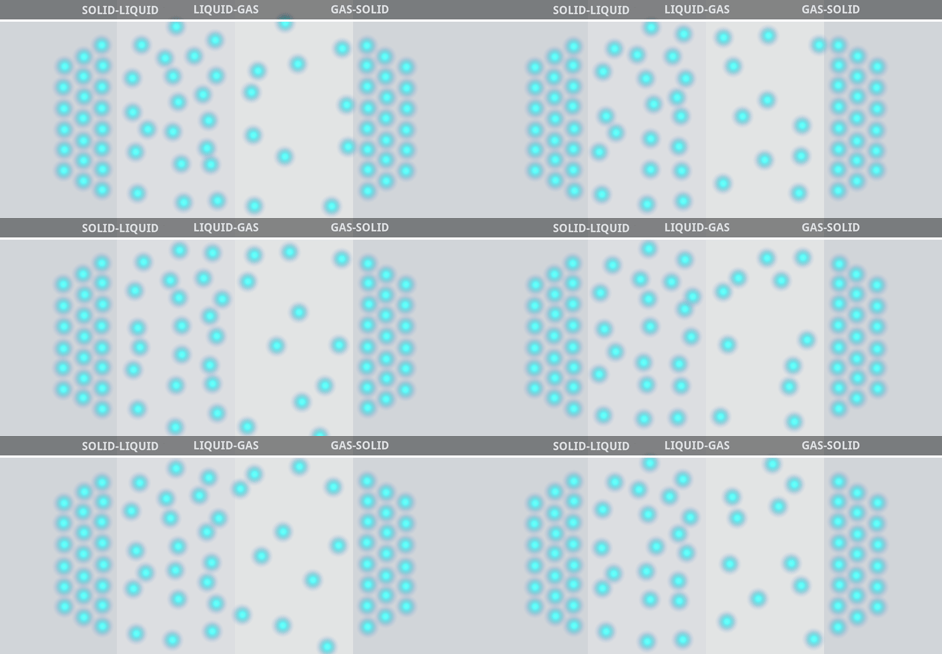
In the interface between two phases or two bodies, the state of atom aggregation and the chemical composition vary abruptly. The surface atoms aren’t at equilibrium because their are neither in one body nor the other, nor in one phase or the other. There is an abundance of unsatisfied bonds, of distorted electron clouds because the surface atoms lost some to neighboring atoms. The excess energy is related to the number of atoms that make up the surface and is, therefore proportional to the surface area.
By convention, the term surface is used for the frontier that separates two phases, one of which is a gas. Also by convention, the frontier between two non-gaseous phases, is called an interface. When dealing with phases in a solid, there are grain boundaries, that are surfaces between crystalline regions with distinct crystallographic orientations.
The surfaces are important in the study of microstructures, friction, wear, material junctions (any materials through any process), chemical catalysts, oxidation, corrosion, mechanical behavior of tiny or thin bodies, electronic components, in the end, a wide variety of other phenomena.