Consider a liquid-solid interface, for example, the interaction of water with the walls of a glass capillary tube. The atoms of the hydrophilic surface of the glass react with the water molecules. Because of the movement of the water and surface energy γ, molecular layers of H2O become stuck to the walls of the glass, above the initial level. These successive layers are firmly attached to the tube, where the interaction is stronger, and become progressively weaker the further away from the wall they become. Vapour molecules also help in this process, as they condense on the neighboring wall surface (see the animation in Figure 2.3.3 below and 2.3.4 in the next post). The end (macroscopic) of the process is a formation of a ring of water (a meniscus).
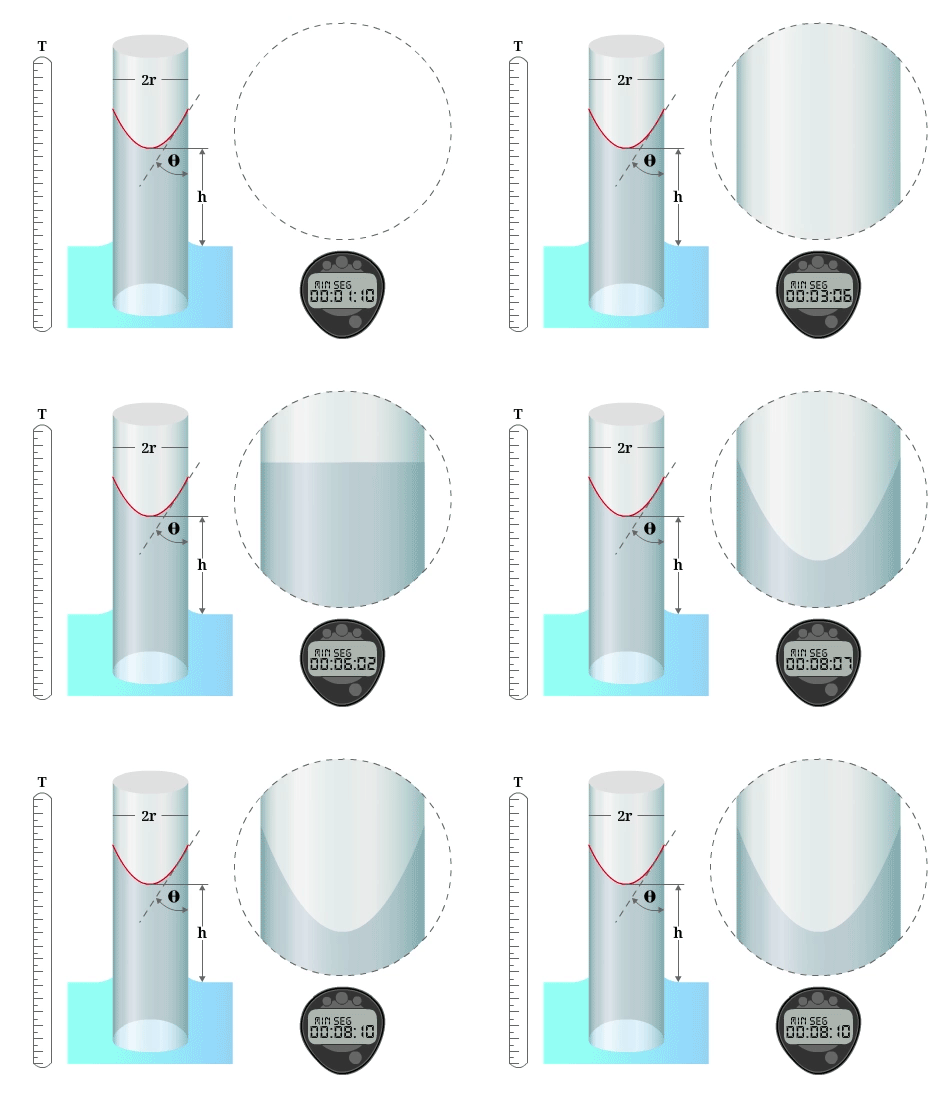
Temperature plays a central role in this process. The higher the temperature of the water, the lower the height of the meniscus. The lower the temperature, the higher the meniscus.
Macroscopically this occurs because, the higher the temperature, the lower the viscosity η (η = τ/D, η is the dynamic viscosity, sigma is the shear stress and D the shear rate) of the water. With a lower viscosity (which is the measurement of internal friction of the liquid), there is more fluidity and a lower height the meniscus will be able to reach.
From the atomic and molecular point of view, the surface tension diminishes with temperature because the increase in thermal agitation of the water molecules increases the average distance between them and reduces the magnitude of intermolecular attractive forces (in the case of water, hydrogen bonds). Table 2.3.1 shows the surface tension values (γ) [units: mN (miliNewton)/m(meter)] and the interfacial tension (with water) (γi) of some liquids at 20 oC. At this temperature, γ of water is ~ 72,8mN/m. At 100 oC the value is approximately 59mN/m.

Note that γ is much larger for metals (compare the value of Hg with water). The reason is that the forces that maintain the water molecules united (hydrogen bonds) are much weaker the bonds between metal atoms in a liquid state.