Currently, research in Atomic Mobility has had a resurgence with the creation of the field of Biological Materials. A come back that uses all the development in the metallic, ceramic, polymer and composites areas.
The following is a summary of atomic motion.
From the point of view of thermodynamics, diffusion eliminates free energy gradients (ΔG). Finally, from the atomist point of view, diffusion is the result effect of random atomic movement. Fick’s first and second laws are mathematical formulas utilized in diffusion processes. The mechanisms with which the atoms move in the lattice depends on the crystalline structure, on atomic size and the extent of defects in the crystal.
Even though the movement of each individual particle or molecule is always obstructed by neighbor atoms or particles, the final result of a large number of these events is a specific global dislocation of material. From the point of view of thermodynamics, the process of diffusion is irreversible because it increases entropy. In most solids, the atoms are strongly tied to their equilibrium positions. Because of thermal vibration atoms move randomly throughout the lattice, a large number these dislocations results in a large transport of material. This is called solid-state diffusion. Even in pure substances an atom can change position within the material, this is known as auto-diffusion. In a mixture of more than one component, for example the bonds of binary metals, occurs the interdiffusion or impurity diffusion, that is, the diffusion of a component through the lattice of the other.
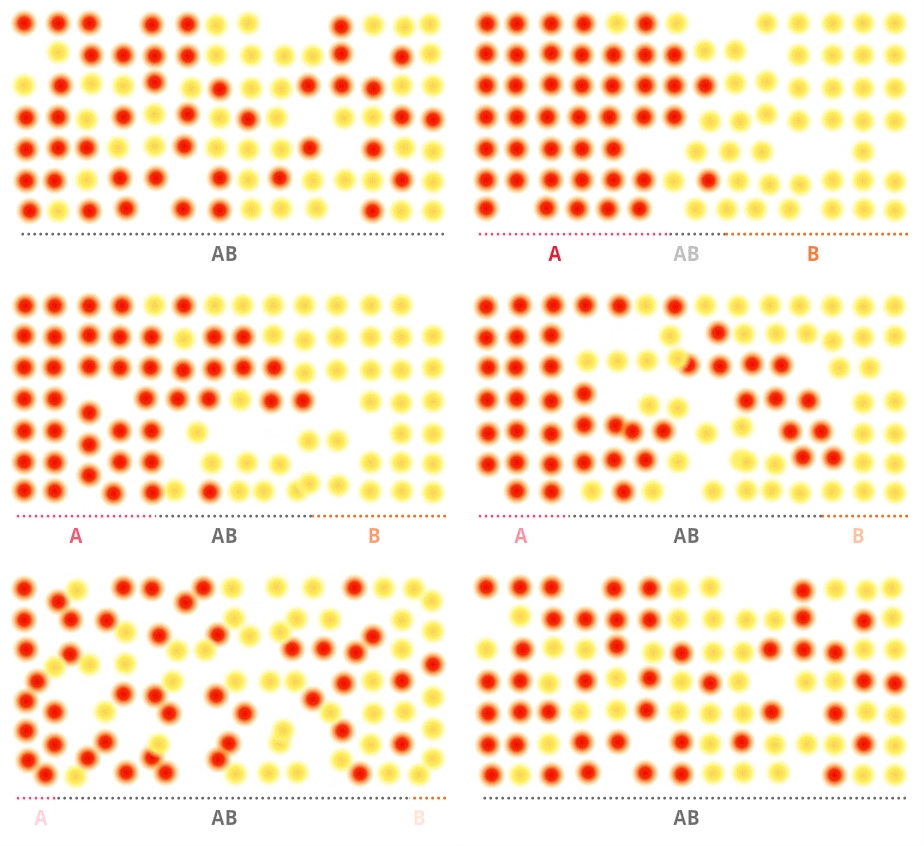
As an example of how diffusion promotes the increase in entropy (ΔS), consider the interdiffusion of components A and B, of a hypothetical system A—B, in a completely soluble solid phase. This process is illustrated in Figure 2.2.1. The blocks of A and of B are placed side by side and heated up to a temperature that will favor diffusion. Block A could be rich in copper (Cu) and block B rich in nickel (Ni), for example. B will probably diffuse into A and visa versa, until they reach equilibrium. This process is irreversible and the bond won’t go back to its original configuration.