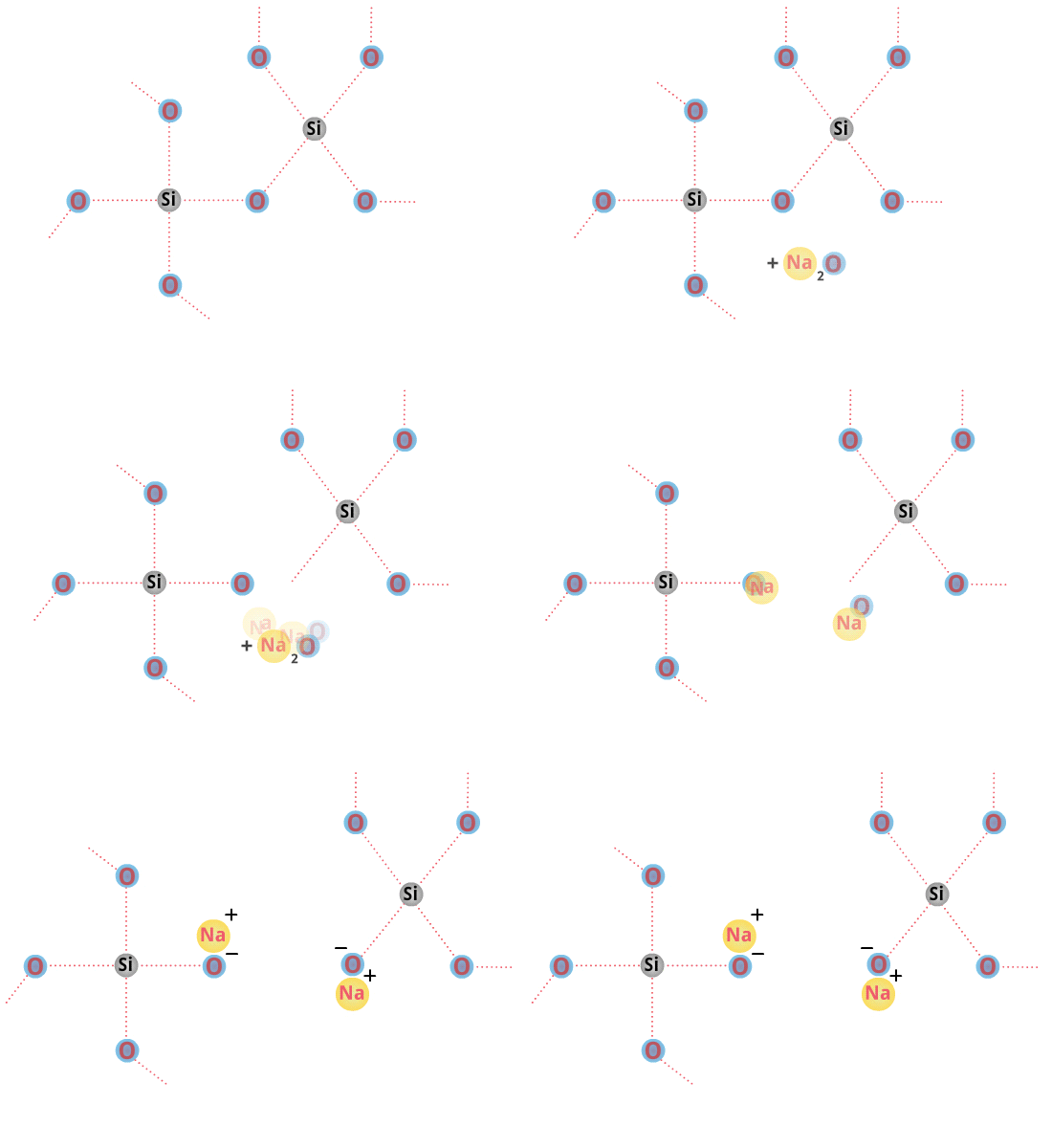
In amorphous and vitreous solids, diffusion depends on the type of bonds and the structure, that is, for sub-nanometric distances, random. For example, the polymers are characterized by strong primary bonds (covalent) that maintain the molecules cohesive, and by secondary bonds that are much weaker between molecules. Diffusion in polymers happens by the movement of entire molecules, analogous to the interstitial mechanism of crystalline materials. If the polymer chain is long and voluminous, movement becomes more difficult; to determine the molecular weight of the polymer, use the rate of diffusion. In inorganic glass, many species “take advantage of” the irregularities in the structure.
The material whose behavior served as a base for elaboration of the diffusion model in glass is silica (SiO2). Vitreous silica and quartz glass describe a process with different methods of accumulating the same material: silica in an amorphous or vitreous state. Synthetic vitreous silica is created through the sinterization of amorphous nanoparticles, obtained by oxidation of silicon halides (specifically, SiCl4) while quartz glass can be made by fusion of mineral powder. In the literature, silicate glass (v-SiO2) is used as a structure model for amorphous materials and glass. The v-SiO2 is also obtained abiotically in the skeletons of glass sponges (Hexactinellid sponges), in sponge spikes, etc. But, it was the comprehension of the formation mechanisms of amorphous solids of silicate (silicate glass) that provided the elements necessary to understand the amorphous organization of other materials like calcium carbonate and phosphate. In silicate glass, the silicon ions (Si) are strongly bonded to the oxygen and the diffusivity of the silicon in these materials is extremely low. Considering everything, the irregular network of silicate contains a large number of positions for cations, which usually fill in a small fraction of the existing vacancies. The presence of empty spaces in the network of quartz glass can be pode ser avaliada by the fact that the density of alpha phase quartz (a-SiO2) is 2.65g/cm3. while the density of quartz glass (v-SiO2) is 2.20g/cm3.
While the silicon ions are at the center of the silicate tetrahedrons, encircles by oxygen ions, the cations of metallic alkynes – especially sodium (Na) – occupy existing vacancies in the random three dimensional network that forms glass, and maintain their positions with weaker bonds than the ionic bonds. Em conseqüência, o sódio (Na), o potássio (K), elementos divalents e trivalentes podem ocupar posições na rede de vidros de silicato com facilidade. The principle compositional components of window glass, for example, are (67.1%SiO2, 14.6Na2O, 8.78CaO, 3.76MgO, 1.01Al2O3, 0.6K2O) by weight. Along with this, the vacancies in the silicate network permit that small atoms like hydrogen (H) and helium (He) diffuse quickly. This transparency of hydrogen and helium limits the use of glass for applications that demand large vacuums. The diffusion of H2, H2O and OH- through vitreous silica (v-SiO2, also called quartz glass) is responsible for the degradation of fibre optics (made of v-SiO2) , especially in submarine cables.
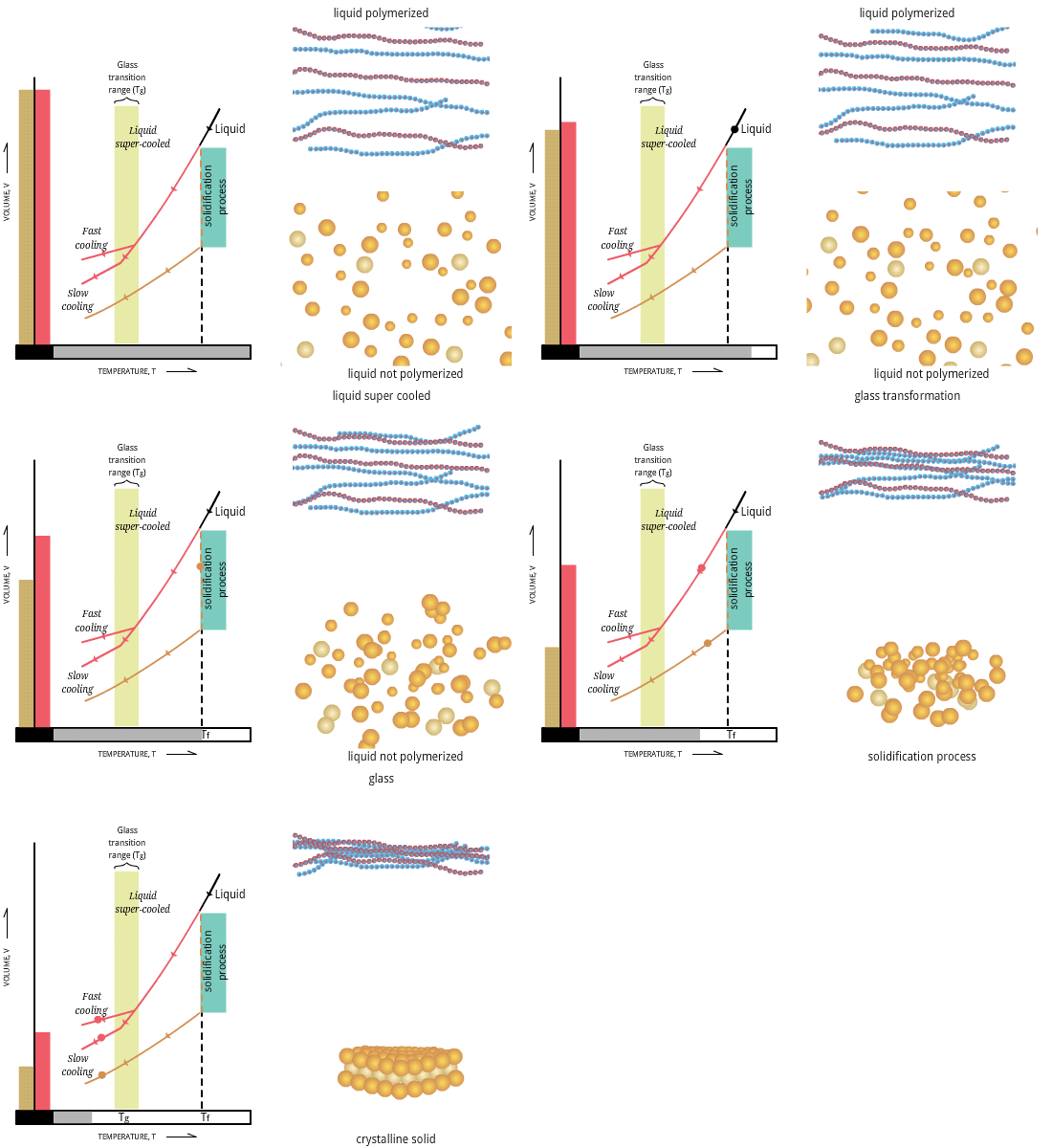
, or as vitreous material without a defined melting point which presents a vitreous transition (Tg).