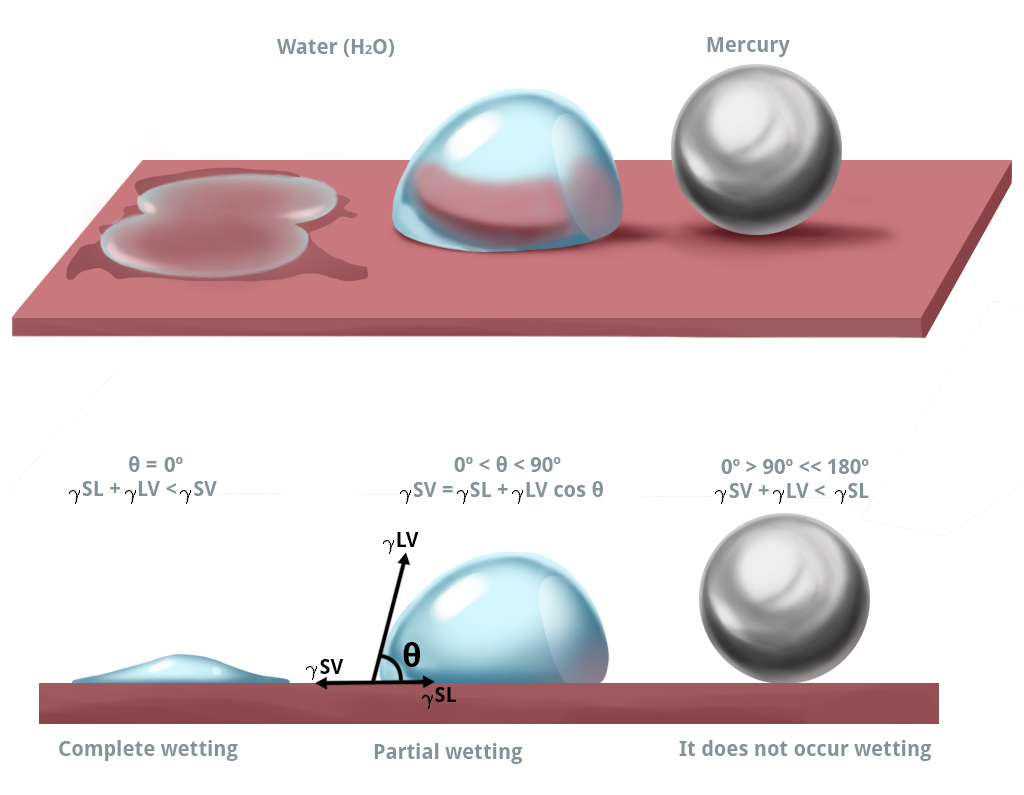
Wetting is the displacement, on a surface, of one fluid over another. It involves, however, three phases, where at least two of them are fluids (liquid or gas).
Consider the case of a liquid that moves air and wets a solid surface, that is, the liquid spreads over the solid surface, rather than forming a spherical drop. From the surface energy point of view , we have
\[\gamma _ {Solid – Liquid (SL)} + \gamma _ {Liquid – Vapour (LV)} <\gamma _ {Solid - Vapour (SV)} \tag{3.5}\]
that is, the total surface energy is reduced by the substitution of a solid-vapor (SV) surface for a solid-liquid interface (SL) and a Liquid—Vapor (LV) surface. On the contrary, there would be no wetting if
\[\gamma _ {SV} + \gamma _ {LV} <\gamma _ {SL} \tag{3.6}\]
The cases of wetting or nonwetting are present in Figure 2.3.7, together with partial wetting, that lets us do the quantitative calculation of surface energy. For partial wetting, having equilibrium of forces between the three surface tensions and the system at rest, we have
\[\gamma_{SV}=\gamma_{SL}+\gamma_{LV}cos\theta \tag{3.7} \]