In nature, the nucleation process almost always occurs heterogeneously, that is, nucleation initiated around a substrate. In the case of biomineralization, heterogeneous nucleation appears to be exclusive. No published homogeneous nucleation in biological systems cases were encountered.
The transformation occurs on favorable sites (substrates), that act as a nucleation process – these favorable sites are existing surface area around grain contours, impurities (second phase particles), chemically favorable regions on organic matrices, proteins with specific ion affinities, etc, and are called nucleating agents.
The essential factor for heterogeneous nucleation to occur is that the catalizing surface needs to be “wetted” by the new nucleated phase. Consider that the solid particles that form on the walls of the mould to be spherical caps. If the walls of the mould are “wetted” by the liquid, we have the situation described in Figure 2.1.10.
The equilibrium of forces where the three surfaces encounter is:
\[\gamma_{MS}=\gamma_{ML}-\gamma_{SL^{cos\theta}} \tag{1.16} \]
where \(\gamma_{ML}\), \(\gamma_{MS}\) and \(\gamma_{SL}\) are the surface tension between the wall of the mould and the liquid, between the mould and the solid and between the solid and liquid respectively.
Figure 2.1.10 shows that the nucleated particle on the mold wall, like a spherical mound, does not vary, in other words the growth of the particle doesn’t alter its form.
Returning to Figure 2.1.10 two aspects can be deduced:
(a) the area interface mould-solid, AMS, substitutes an equivalent quantity of area of the mould-liquid interface, AML;
(b) \(\gamma_{MS}\) is smaller than \(\gamma_{ML}\).

The creation of MS surface then reduces the energy associated with the area it occupies. The decrease in energy can be attributed to removal of energy from the surface SL, resulting in the total surface energy of heterogeneous nucleation which is usually much lower than the surface energy for homogeneous nucleation. It can be said, therefore, that the energetic barrier to be overcome in heterogeneous nucleation is much lower than that of homogeneous nucleation.:
\[\triangle G^{* ( heterogênea ) }<<\triangle G^{* ( homogênea ) } \tag{1.17} \]
The energetic barrier associated with the formation of a critical sized nucleus, with spherical mounds form, by heterogeneous nucleation on the mould walls is shown with the following expression:
\[\triangle G^{*(hom)}=\triangle G^{*(het)}f(\theta) \tag{1.18} \]
where \(\theta\) is the angle of wetting. \(f(\theta)\)is itself a factor whose expression form is:
\[f(\theta)=(2+3cos\theta+cos^{3}\theta)^{2}\text / 4 \tag{1.19} \]
Equation (1.18) shows that the energetic barrier for nucleation on a substrate decreases with a decrease of \(\theta\) and approaches zero as \(\theta\) approaches zero. For \(\theta= 0°\), theoretically an energetic barrier doesn’t exist to be overcome for nucleation on a substrate. In this way, even if the number of possible heterogeneous nucleation sites is small, the particles will still prefer to nucleate on the surfaces rather than in the interior of the liquid. Figure 2.1.12 graphically shows the\(f(\theta)\)factor that converts the energetic barrier of homogeneous nucleation to heterogeneous as a function of the angle \(\theta\). It can be seen that even for \(\theta\) =90, that represents the limit of the equation (1.18), the factor is still equal to 0.50. This means that even if a liquid only partially wets the substrate, the energy needed for heterogeneous nucleation is still half that need for homogeneous nucleation. For a liquid that significantly wets the substrate (small \(\theta\)) for example 30°, the quotient of Figure 2.1.11 is equal to 0.02. Therefore, the energy for heterogeneous nucleation is 50 times smaller than that of homogeneous.


The heterogeneous nucleation speed curve should be similar to Figure 2.1.10, except for the fact that heterogeneous nucleation can initiate in temperatures much higher than those expected for homogeneous nucleation. Heterogeneous nucleation reduces and sometimes even eliminates supercooling. For stationary state the speed of heterogeneous nucleation can expressed as:
\[\mid=n ^ {(het)} .v.exp(\frac{∆G _ {D}+∆G ^{*(het)}}{kT}) \tag{1.20} \]
where n(het) is the number of atoms (or molecules) in the liquid phase, per unit of area, in contact with the wall of the mould, and is the frequency of vibration, ∆GD is the activation energy for diffusion, k is the Boltzmann constant, T is the absolute temperature (K) and ∆G*(het) is the activation energy for heterogeneous nucleation process. Figure 2.1.13 is an animation of heterogeneous growth of a new phase starting from a gaseous phase.


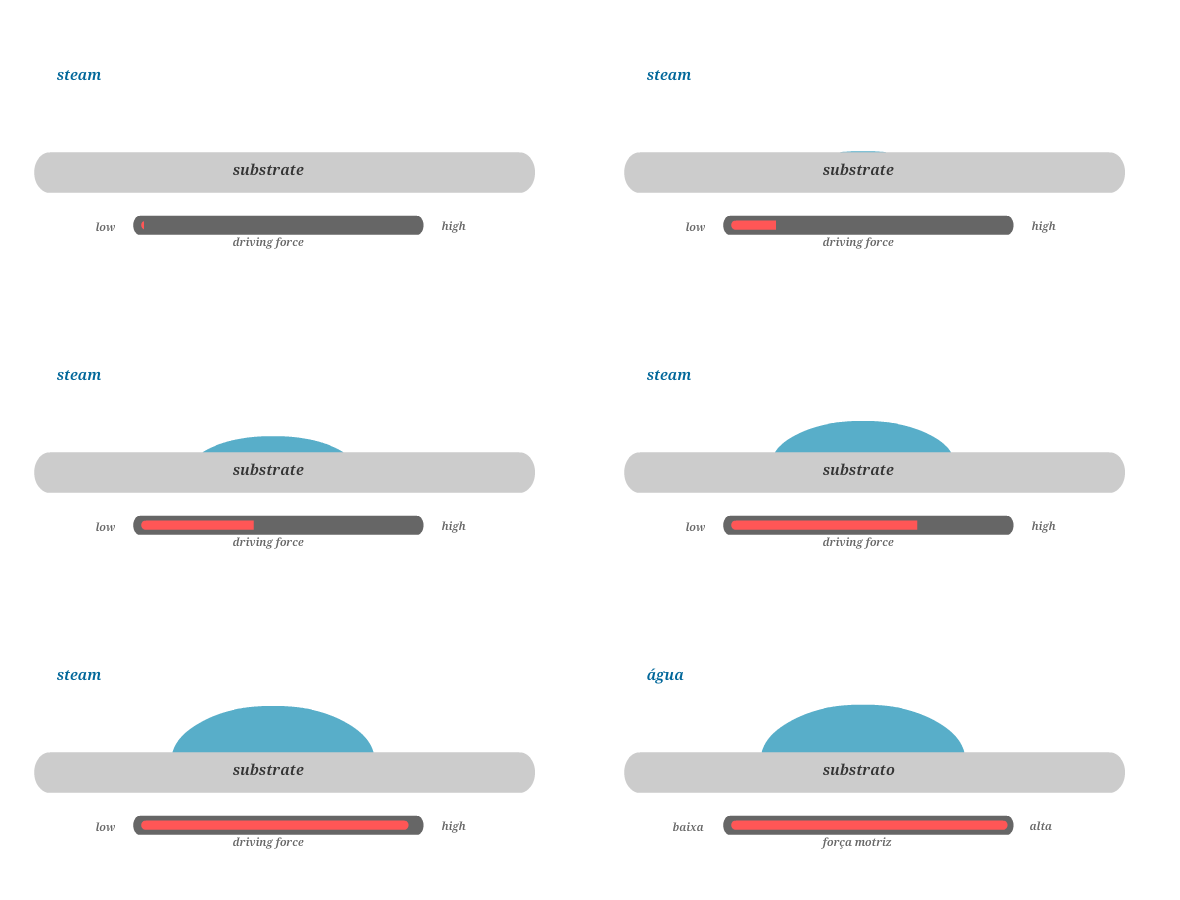
Figure 2.1.13 – Heterogeneous growth of a new phase from a gaseous phase. Note the geometrical alteration (of a bidimensional plate to a tridimensional spherical cap) as a function of the value of the force of the process