Suppose that a bar of a pure metal A is united with another bar of pure metal B. The bars are considered semi-infinite, that is, they begin at the union of the bars but, in the opposite direction from the junction. The bars are much larger than the distance that the atoms that diffused could reach, even with large experimental times (days). In general, the distances involved in diffusion experiments are on the order of micrometers or millimeters. The initial concentration of B is C 0, which will diffuse into the bar full of atoms A. This system is presented in Figure 2.2.20, in a graphic with concentration C of the atom or molecule diffusing (solute) as a function of the distance x. The origin of the system is located between the two bars.
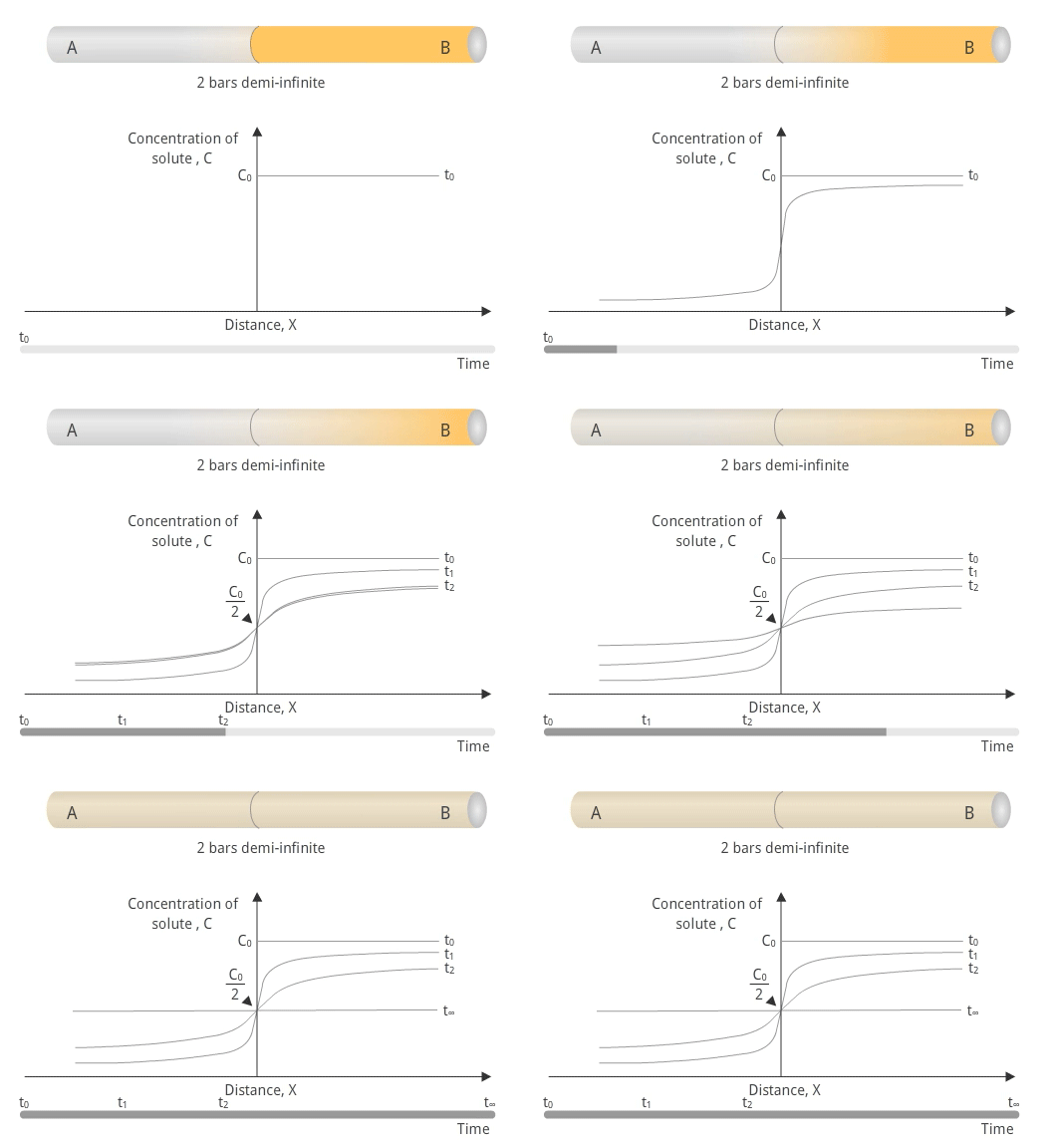
The following boundary conditions or hypothesis should be assumed in this case:
a- For x > 0, we have C = 0 when t=0.
b- For x ≥ 0, we have C = C 0 when t = 0.
With these conditions the solution of the equation (2.7) is:
\[ C(x,t) = \frac{C _ {0}}{2}[1+erf(\frac{x}{2\sqrt{Dt}})] \tag{2.26} \]
Note that the error function (erf) assumes the following:
1- erf (∞) = 1.
2- erf (0) = 0.