The next three topics will present the description of a physical problem of diffusion, the boundary conditions the modeling of the problem demands and the solution1 of the partial differential equation. This mathematical equation is Fick’s Second Law (see the last topic).
An experimental technique used for measuring the diffusion coefficient D involves the application of a thin film2 of radioactive material over a pure metal (host), and is called the radioactive tracer method. Consider two semi-infinite rods, of the same pure metal, rich in metal A, bound at their extremities and, between them a thin film of the amount of metal B that will spread to the inside of the two bars. The solute can be an isotope3 of the bar’s metal. This system is presented in Figure 2.2.19, in a graphic of C concentration of the species in diffusion (solute) in function of the distance x. The origin of the system is the film.
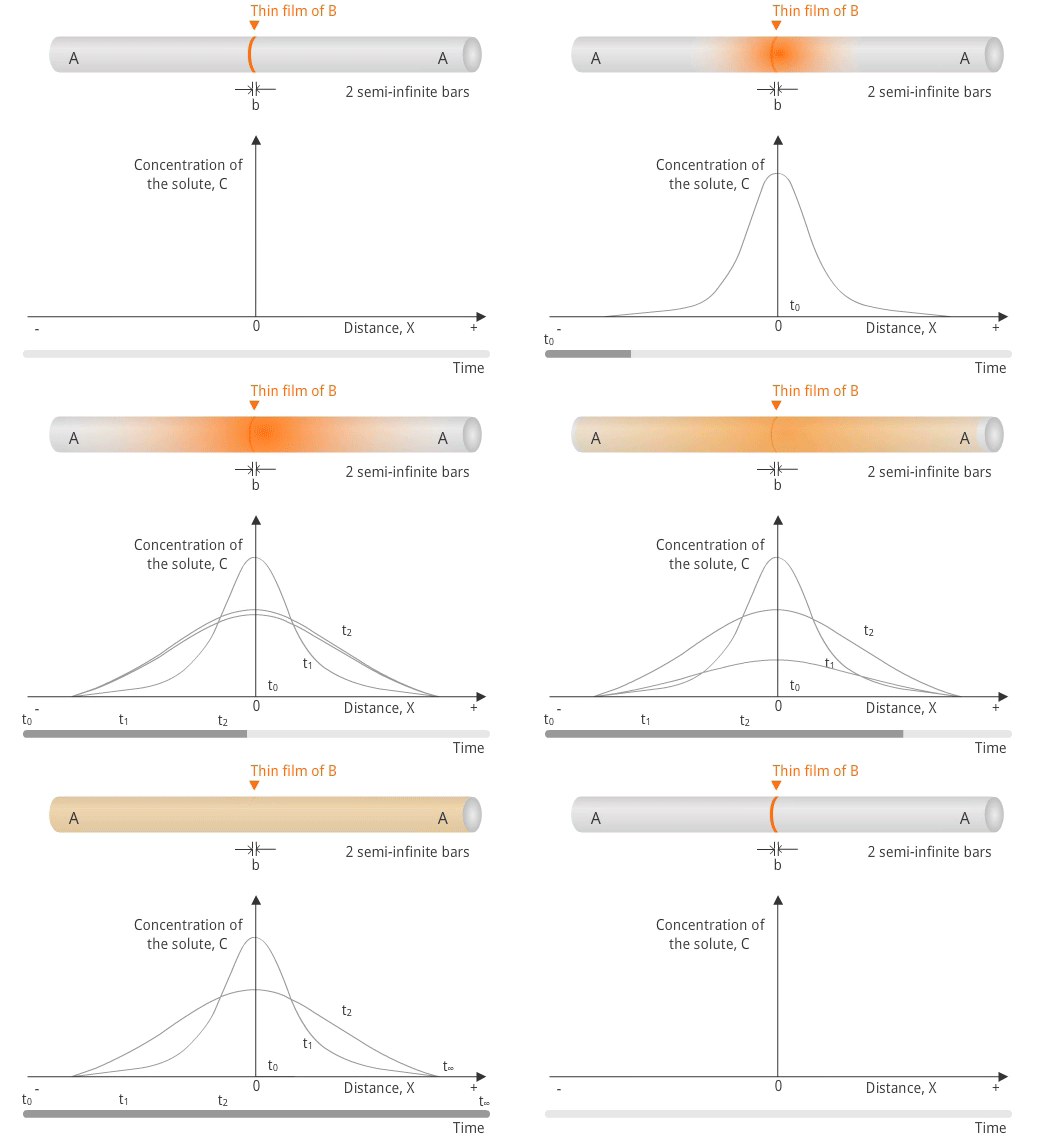
Figure 2.2.18 – Variation of the concentration of the solute C with the distance of x, for a system made up of two semi-infinite bars, bound with a film between them.
To solve the differential equation (2.7), Fick’s second Law, \( \frac{\partial C}{\partial t} = D \frac{\partial ^2 C}{\partial x ^ 2} \) the boundary conditions are needed that express, mathematically, the previous proposed problem. These conditions are:
a- For |x| > 0 , we have C → 0 when t → 0 .
b- For x = 0 , we have C → ∞ when t → 0 .
c- For x = 0 , we have \( \frac{\alpha}{2\sqrt{\pi Dt}} \) when t > 0 .
d- For t → ∞ , we have C → 0 when t > 0 .
With these conditions the solution of equation (2.7) is:
\[ C(x,t) = \frac{\alpha}{2\sqrt{\pi Dt}}exp(-\frac{x ^ {2}}{4Dt}) \tag{2.25} \]
The important parameter is \( \chi \approx \sqrt{Dt} \) which indicates, approximately, the diffusion distance during time t. An example of this case is the diffusion of a radioactive noble metal (the radioactive isotope of gold Au195 , for example, in bars of gold where the initial diffusion pair is a source of radioactive noble metal. The time of this experiment varies from tens of hours to tens of days and the temperatures utilized are controlled between 80-95% of the metal’s melting point.
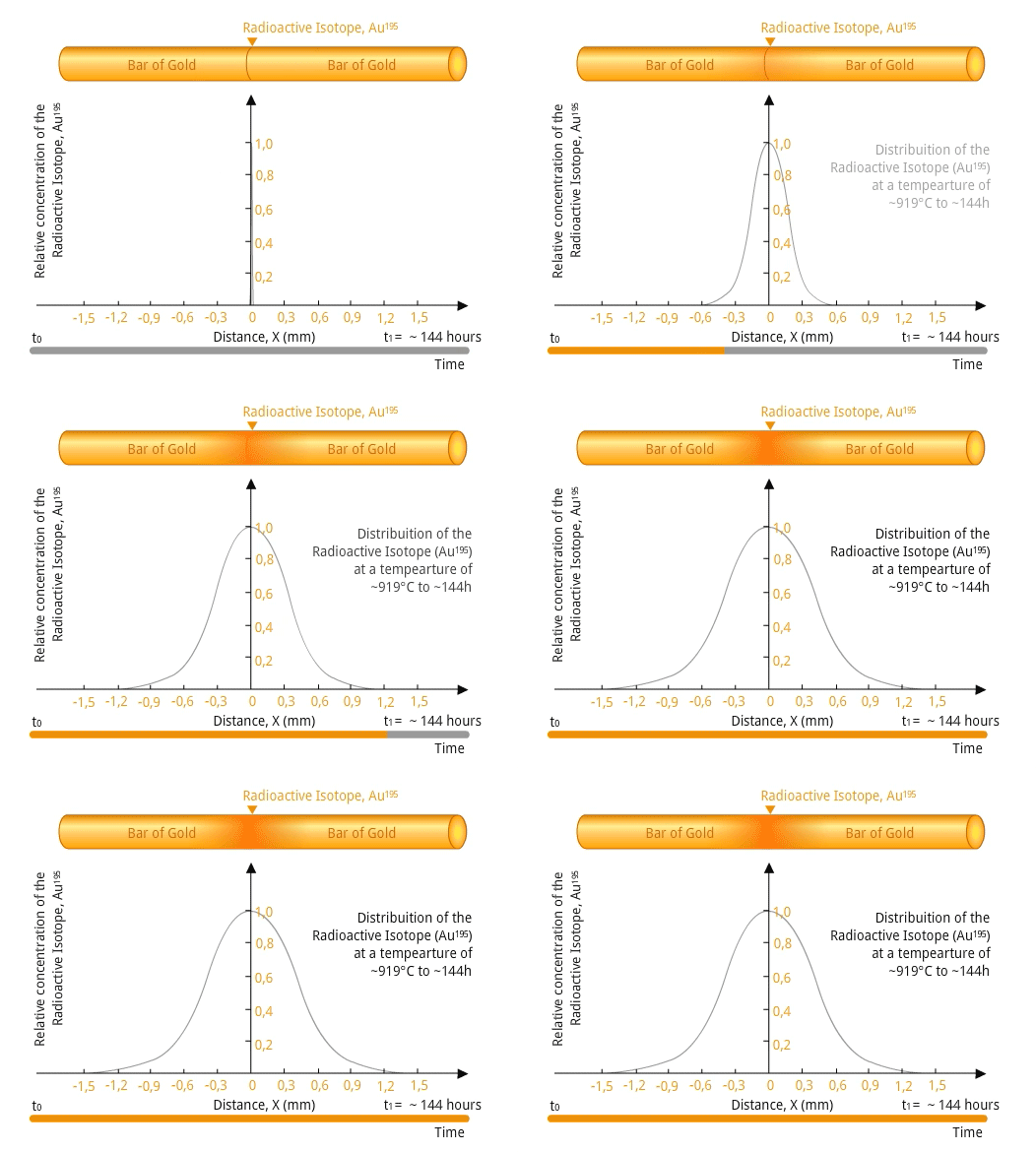
Figure 2.2.19 – Distribution of atoms of the radioactive isotope Au195 , after diffusion for ~144 hours at (919 ± 2) ° C in an electromigration experiment.
1 A partial differential equation is an equation involving an icognita function with varios independant and its partially derivedvariables independentes e suas derivadas parciais em função destas variáveis. Differential equations are used to model phenomenons and later solve mathematical problems that involve functions with various variables, like what happens in the propagation of heat, sound flows, diffusion etc.
A solution to a partially derivated equation is an equation, obtained for prefixed boundary conditions.
2 A thin film is a thin layer of material that can vary from 1 nanometer (nm) to a few micrometers (m).
3 A chemical element is identified by the number of protons in its nucleus (Z). Atoms with the same number of protons with a different number of neutrons are called isotopes.