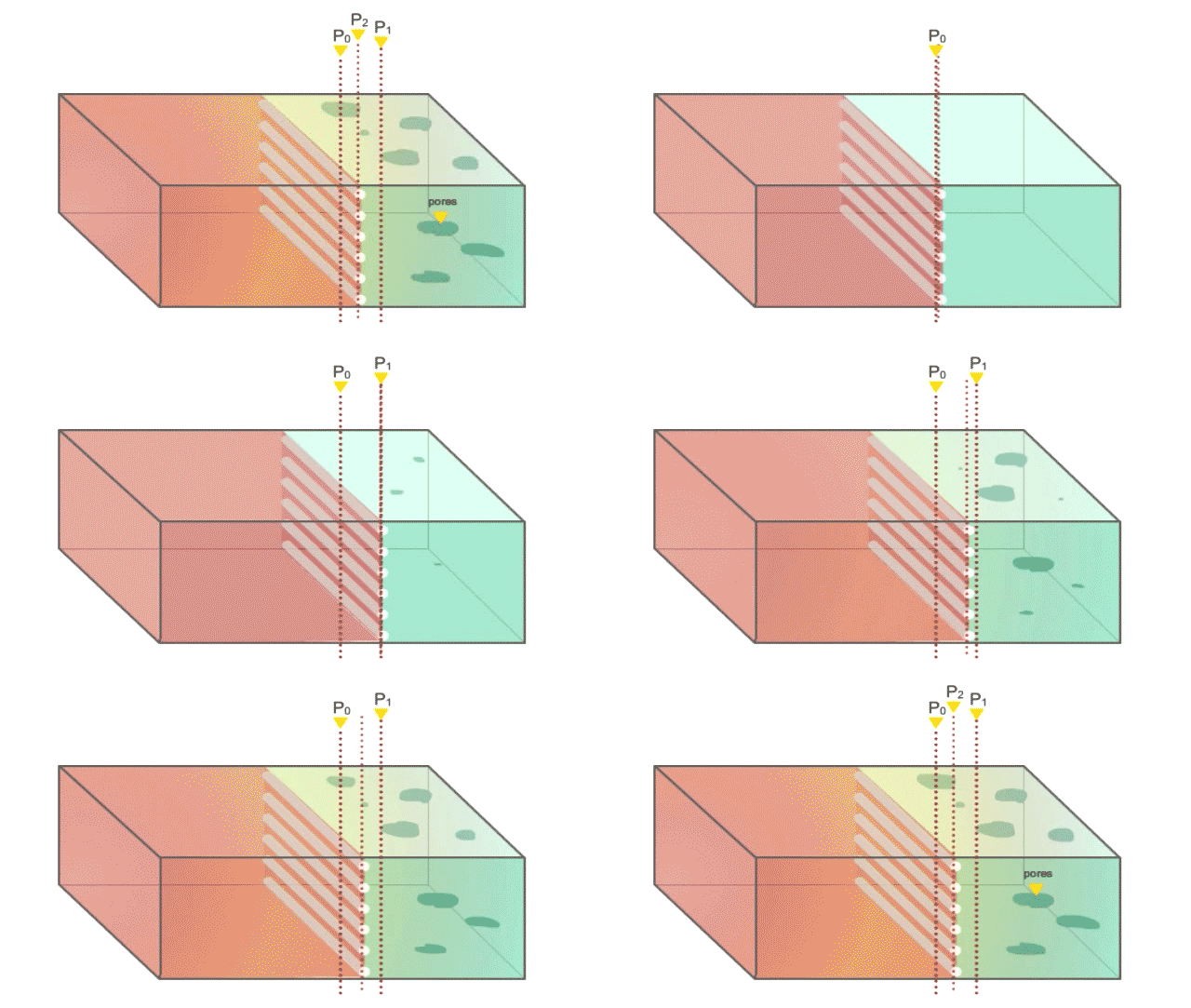
Figura 2.2.12: The Kirkendall Effect.
Consider the experiment in Figure 2.2.12. Here there are two blocks of materials, A and B, bound together as a core encased in the other. A marker substance whose properties won’t be modified at the test temperature is placed on the interface between the two blocks. This set is called a diffusion pair. The block is put into an oven at an appropriate temperature and after a determined amount of time the surface marker migration from interface is observed, as the appearance of vacancies on the B side. This effect was first discovered in metallic substances in 1947 by Kirkendall1 who used copper and brass and is generally accepted as evidence of diffusion by the vacancy mechanism. Until Kirkendall’s work it was believed that diffusion in metals occurs through direct exchange mechanism or by the ring mechanism in a way that would equalize fluxes in binary bonds. Kirkendall, however, found differences in the fluxes in diffusions with zinc (Zn) and copper (Cu) in a copper and brass diffusion pairing (70% Cu-30% Zn).
The explanation for this inequality is the key difference in the diffusion velocity, having real dislocation of massa and of vacancies by way of the original interface A—B, in other words, a large flux of vacancies occurs to the right and a movement of atoms of B to the left.
The Kirkendall Effect shows that the interdiffusion of binary bonds (with a single coefficient D) consists of two classes of movement, those of A atoms and those of B atoms. A 1948 study done by L. Darken generated the following expression known as the Darken equation:
\[D = X _ {B} D _ {A} + X _ {A} D _ {B} \tag{2.14} \]
where XB, XA are molar fractions of B and A in the bond in question, DA is the diffusion coefficient of A in pure B and DB is the diffusion of B in pure A.
1Ernest O. Kirkendall (1914-2005), american metalurgist that studied diffusion in metal pairs of copper (Cu) and brass (70% Cu-30% Zn). These studies provided evidence of the differnces (the Kirkendall Effect) of atomic flux in a binary pair.