The biomineralization of animals comes after the splitting off of the main parallel clades, consistent with the idea of parallel evolution of mineralized animal skeletons. The fossil record of sponges and cnidaria suggests that they acquired skeletal biomineralization in the PreCambrian period, but it was after many bilateral groups flourished in the fossil record that the spread of non-bilateral skeletonized organisms like these occurred.
The phylogeny points to duplicated innovations in the evolution of carbonized skeletons, but leaves open the question of homology in the responsible molecular process: the formation of a skeleton requires more than just the ability to precipitate minerals; the precipitation should occur in a controlled way in specific biological environments. It should be remembered that all cells share the ability to bond Ca2+ and regulate calcium ion concentration; the biochemical supply of ions necessary for the precipitation of calcite or aragonite appears to be an ancestral characteristic in eukaryotes, and biochemical similarities extend to molecules that inhibit the mineralization of CaCO3.
Spontaneous calcification of cell/tissue surfaces was probably a common problem in the supersaturated oceans of the Proterozoic era: it’s possible that molecular inhibitors evolved initially as anti-calcification defense mechanisms and only after were used for physiological controls for skeletal growth. In this way the diversity of the origin of calcified skeletons would be a reflection of multiple independent cooptation of molecular/physiological processes widely shared by eukaryotic organisms: skeletons that aren’t structurally homologous possibly share physiological mechanisms.
The first appearance of skeletal elements in animals are associated with beings similar to and including sponges (Figure 1.3), in the Cryogenian period, with spicules dating back to approximately 750 Ma. They have a uniaxial structure, hollow, with thin walls composed of silicate dioxide. The first calcareous spicules probably presented calcite constitution with a high concentration of magnesium, and appears in the fossil record approximately 550 Ma.
 Figure 1.3 – Glass Sponge on left, fossil on right.
The oldest Cnidariomorphos fossils (Figure 1.4) are represented by solitary tubular forms without spicules, probably of aragonite or calcite with high concentrations of magnesium, around 545 Ma.
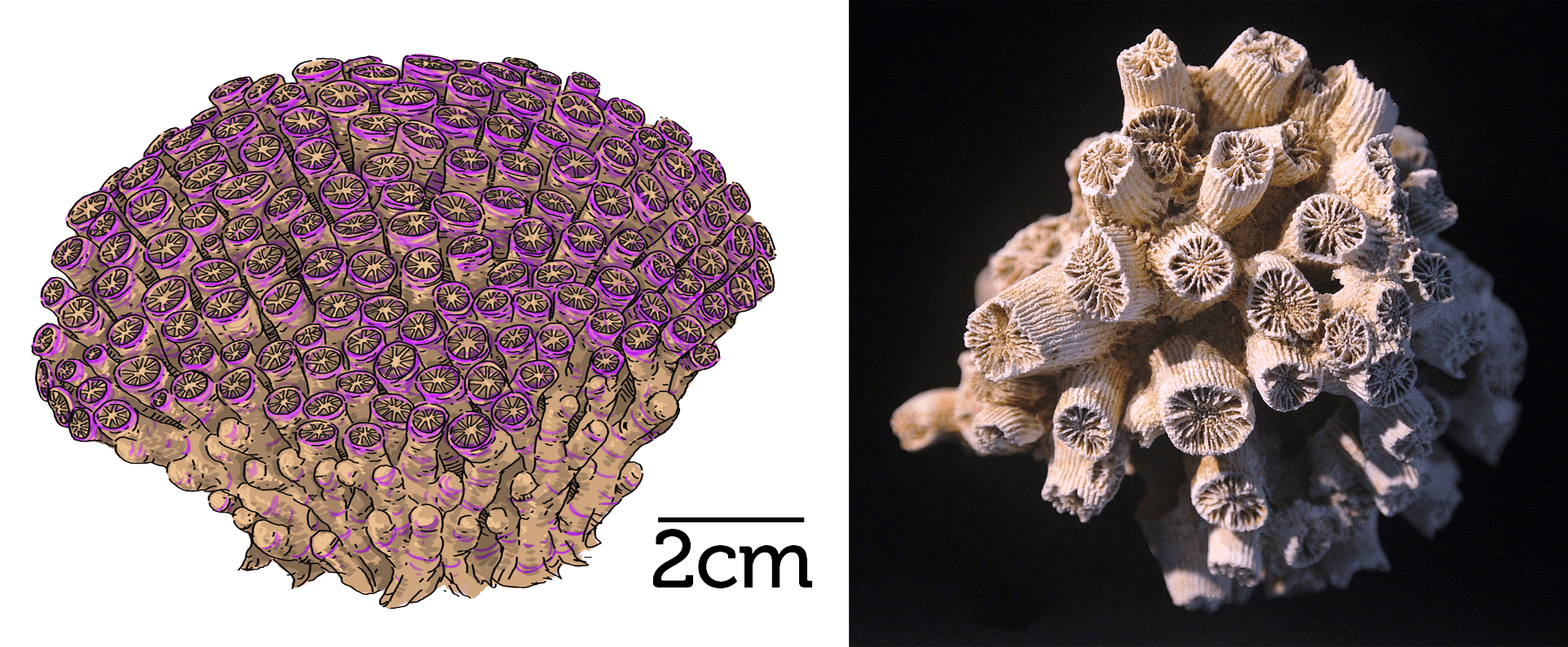
Figure 1.4 – Cladocora sp. Shown on the left, fossil on right. Image of fossil from commons.wikimedia.org
The Trilobite class (Figure 1.5) is composed of developed arthropods, with calcite shells of low magnesium concentrations. It appeared for the first time approximately 521 Ma.

Figure 1.5 – Trilobite. Trilobite on the left, fossil on the right. Fossil image obtained from en.wikipedia.org