In many cases, a new phase does not form instantaneously, in its final size, in a supersaturated solution. The growth of the new particulate proceeds by the transfer of material to a growing nucleus, until the global transformation is complete.
When a small region of a stable phase appears, a decrease in free energy (∆G) occurs per unit of volume, which contributed to regional stability. Free Energy is a concept put forth by Josiah Willard Gibbs (1839-1903) which expresses the amount of energy available a body has for physicochemical reactions.
This region is limited by an area of surface and that surface is associated with, at least, positive free energy per unit of area.
The equation 1.1 describes this concept associating it with enthalpy H (internal energy) and entropy S (energy associated with the degree of order of the configuration):
\[ \triangle G=\triangle H-T \triangle S \tag{1.1} \]
Where ∆G is the variation of free energy, ∆H is the variation in enthalpy (internal energy of the body), T is the absolute temperature (measured in Kelvin, ºK) and ∆S is the variation of entropy.
By this theory, the values in the amount of negative free energy (∆G<0) indicate spontaneous reactions like the phenomenon of atomic and molecular diffusion, responsible for nucleation and growth. (∆G>0) indicates that a reaction is not spontaneous and ∆G=0 indicates system equilibrium.
For nucleation, the free energy of the system has two components: ∆GV and ∆GS, GV is the portion of free energy related to the creation of volume and ∆GS is the portion of free energy related to surface creation. In this way, although the substitution of the old phase for the new is accompanied by a decrease in free system energy, the presence of a surface between the two phases produces an increase in free energy.

On the surface of the aggregates, the atoms or molecules interact less with the nearest external neighbors of the embryo. Therefore ∆GS is always a positive term and acts to destabilize the nucleus especially when most of the atoms reside on the embryo surface. In this case the aggregate is extremely unstable but if the nucleus reaches a minimum size (critical size), the drop in free energy associated with volume formation is sufficient that the Surface/Volume relationship reduces the value. As was stated, there is an intermediate size where the free energy of system (G) decreases and the nucleus augments or dissolves – the critical size.
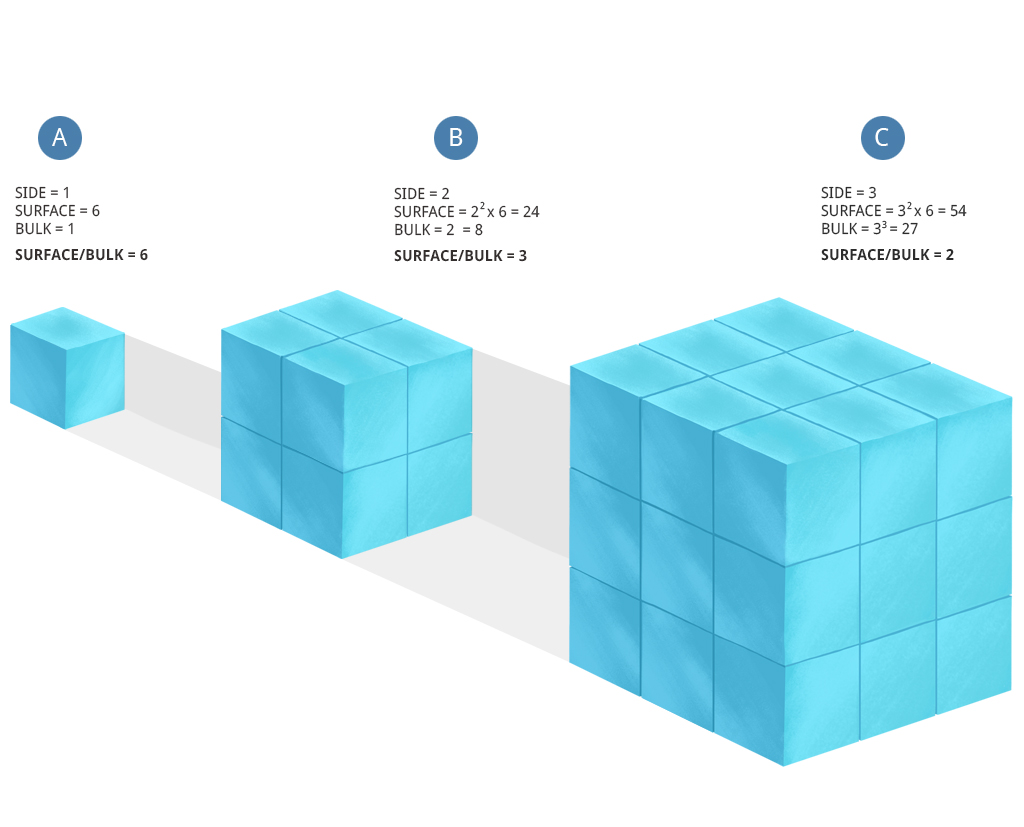
The existence of a critical size for nucleation of a new phase implies that nucleation can be controlled by the modulation of the critical size. Varying the composition of the solution or altering the state variables (i.e. temperature, pressure and volume) of the system creates the possibility of intervening in nucleation – which could explain how organisms control mineral phase nucleation by physiological control of the ion concentration in the intracellular vesicles and in external micro-environments destined for mineralization.
As will be seen in the topic of Heterogeneous Nucleation, the presence of surfaces (like the insoluble organic phases present in shells, bones and carapaces) facilitates nucleation because generally the surface energy between the atomic embryos and a solid substrate is smaller than that of the interface between atomic embryos and the solution.
The two main steps in a phase transformation, Nucleation and Growth, can be subdivided into several sub steps. Each of these sub steps has its own activation energy – the quantity of energy that should be provided by the system, among other examples, a- an increase in temperature, b- a change in pH in micrometric dimensional environments like, microfluids or c- surface energy, for physisorption, for example, in the extrapallial space in mollusk bivalves for the phenomenon to occur. Usually one of the steps runs slower than the rest, this turning out to be the step that limits the over all speed of the process. Nucleation can involve a) the uniting of certain species of atoms (or molecules) by diffusion or other types of transport, b) the formation of one or more unstable intermediate structures and the formation of nuclei of the new phase. Growth can involve the transference of material to the interior of the new phase, by diffusion, by the old phase or by a grain boundary.1
1Grain boundary is a technical term used in Material Sciences and is the interface between two grains: they are superficial imperfections that separate crystals in different orientations, in an aggregated polycrystalline structure.