If a stable crystal nuclei appears in the interior of a liquid, its growth will by the addition of structural units, atoms or molecules, to the nuclei. To cross the interface with a width of a0 as show in Figure 2.1.17 , the atom needs to overcome an energy barrier equal to ∆Ga and once integrated in the new phase, present free energy lower than that of the liquid. This difference is the driving force of the process and corresponds to the difference in free energy of an atom when present in the new phase and when present in the liquid.
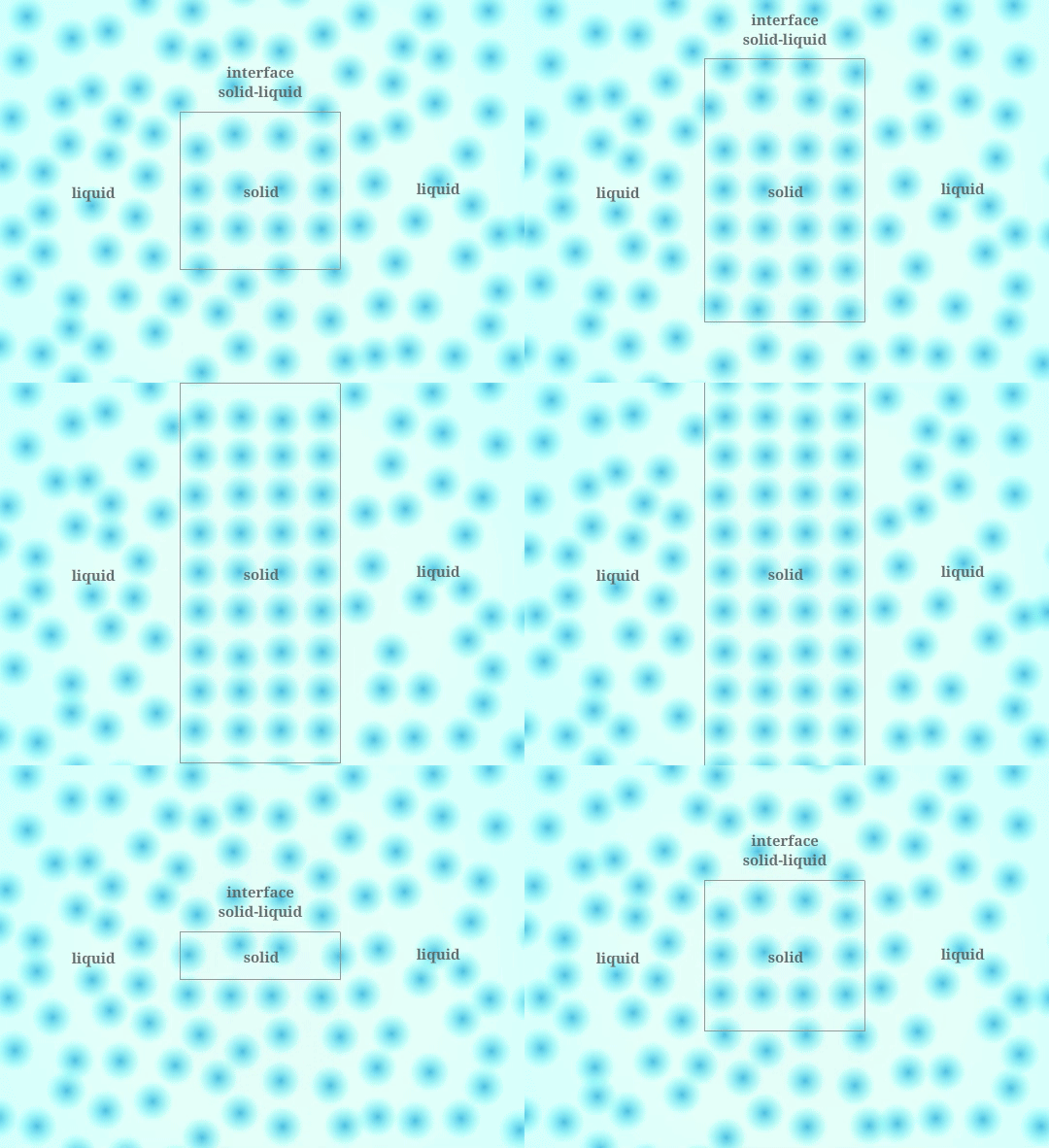
When new phase growth occurs through a simple transfer of atoms of a single component, we ignore the surface and deformation phenomenon, the following equation was proposed for the speed of growth
\[\cup=a _ {0} . v[exp\frac{-∆G _ {a}}{RT} ] [exp\frac{-∆G’}{RT}] \tag{1.21} \]
where U is the liquid speed of growth (speed of transference of matrix atoms ⇌ new crystal phase, a0 is the average width of the interface, v is the frequency of atomic vibrations, R is the universal gas1 constant and T is the absolute temperature (K), ∆Ga is the energy barrier, ∆G’ is the decrease in free energy per mol due to crystallization.
For small supercoolings (T≤Tmelt), the last equation approximates
\[U =a _ {0} v(\frac{∆G’}{RT})[exp(\frac{-∆G _ {a}}{RT})] \tag{1.22} \]
and for large supercoolings (T << Tmelt), ∆G’>>RT and the equation (1.21) can be rewritten as
\[U =a _ {0} v[exp(\frac{-∆G _ {a}}{RT})] \tag{1.23} \]
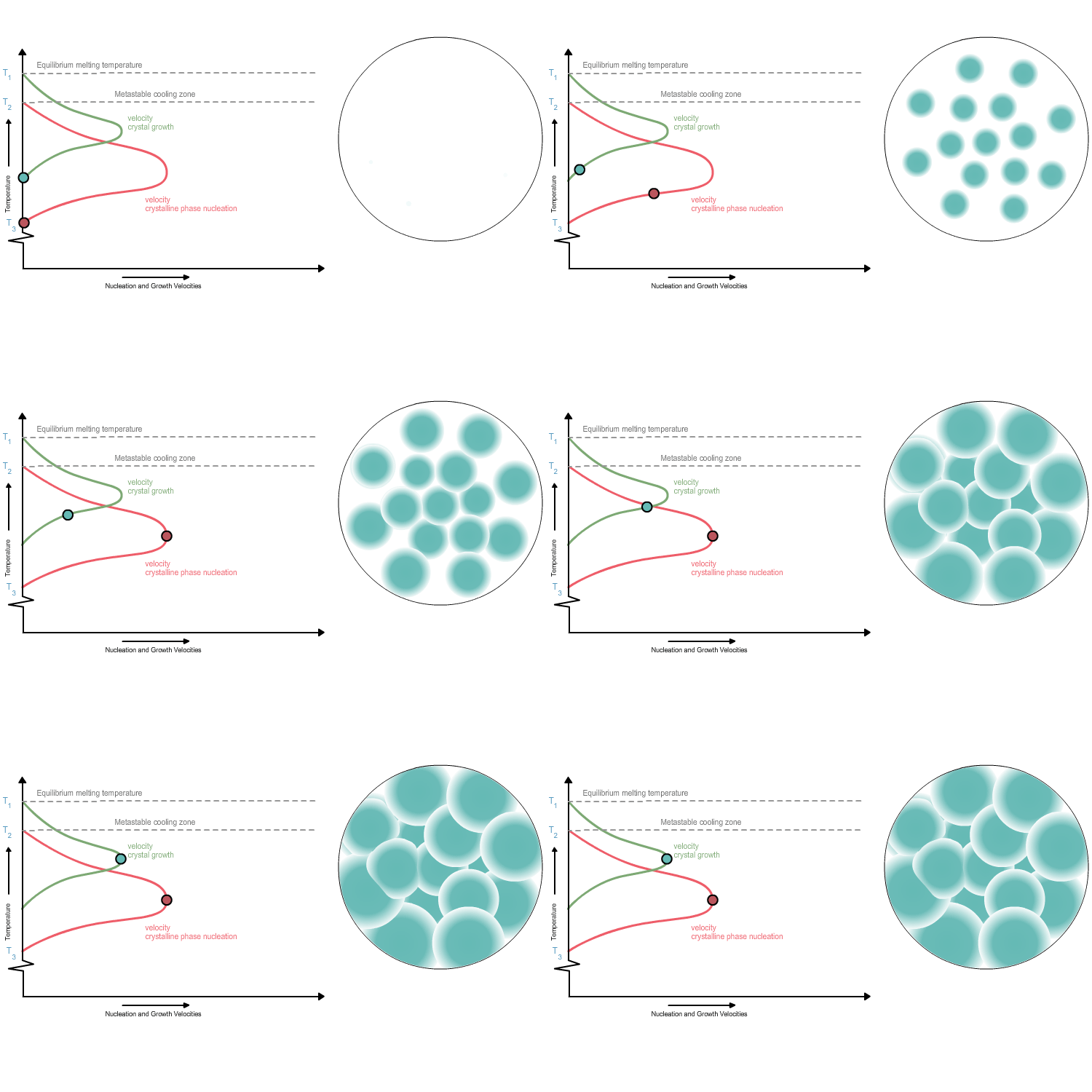
The last equation proves that as T decreases, the speed of growth approaches zero. Since it is null and the melting point temperature (Tmelt or Tf), the maximum rate of growth should at an intermediate temperature. This has been verified through experiments by various researchers on different materials. Figure 2.1.18 shows the rate of nucleation I and the rate of growth U as functions of temperature.
At temperatures near the melting point temperature few nuclei are formed, but growth is quick and the new microstructure will contain few large granules. In lower temperatures, the nucleation rate is relatively large but the growth rate is low. Consequently, transformation in lower temperatures will produce a large number of small grains, commonly called fine grain structures.
1R, universal gas constant, is 8.31 J/mol.K or 0.082 atm.l /mol.K