The growth regime of crystalline phases is controlled by different phenomenon like viscous flow, surface effects, short or long range atomic diffusion, or crystal-matrix interface reactions. The matrix can be a liquid, viscous-elastic (or both), or other crystalline phase. Other mechanisms or the combination of interface effects and diffusion can occur. On this topic a summary of significant points about the mechanics of diffusion and interface will be presented.
The theory of controlled growth by diffusion was first proposed by C. Zener, in 1949. He studied unidimensional growth (increase in thickness of a plate in the normal direction of atomic flow), bidimensional (radial growth of a cylinder) and tridimensional (sphere growth). The two basic formulas, suggested by the author, refer to the crystal/matrix position at a given moment and the speed of growth, expressed by the following equations:
\[U =k \sqrt{\frac{D}{t}} \tag{1.24} \]
and
\[x =k \sqrt{Dt} \tag{1.25} \]
where the k parameter depends on the original concentration of solute in the matrix and the growth dimensions, D is the diffusion coefficient of the solute in the matrix, t is time and x the position of the interface.
These are general equations, as confirmed in previous studies and indicate that the position of the x interface, when diffusion controls growth, varies with the square root of time, and that it’s speed (dx/dt) is inversely proportional to this value \((U \sim \sqrt[\frac{1}{t}])\)
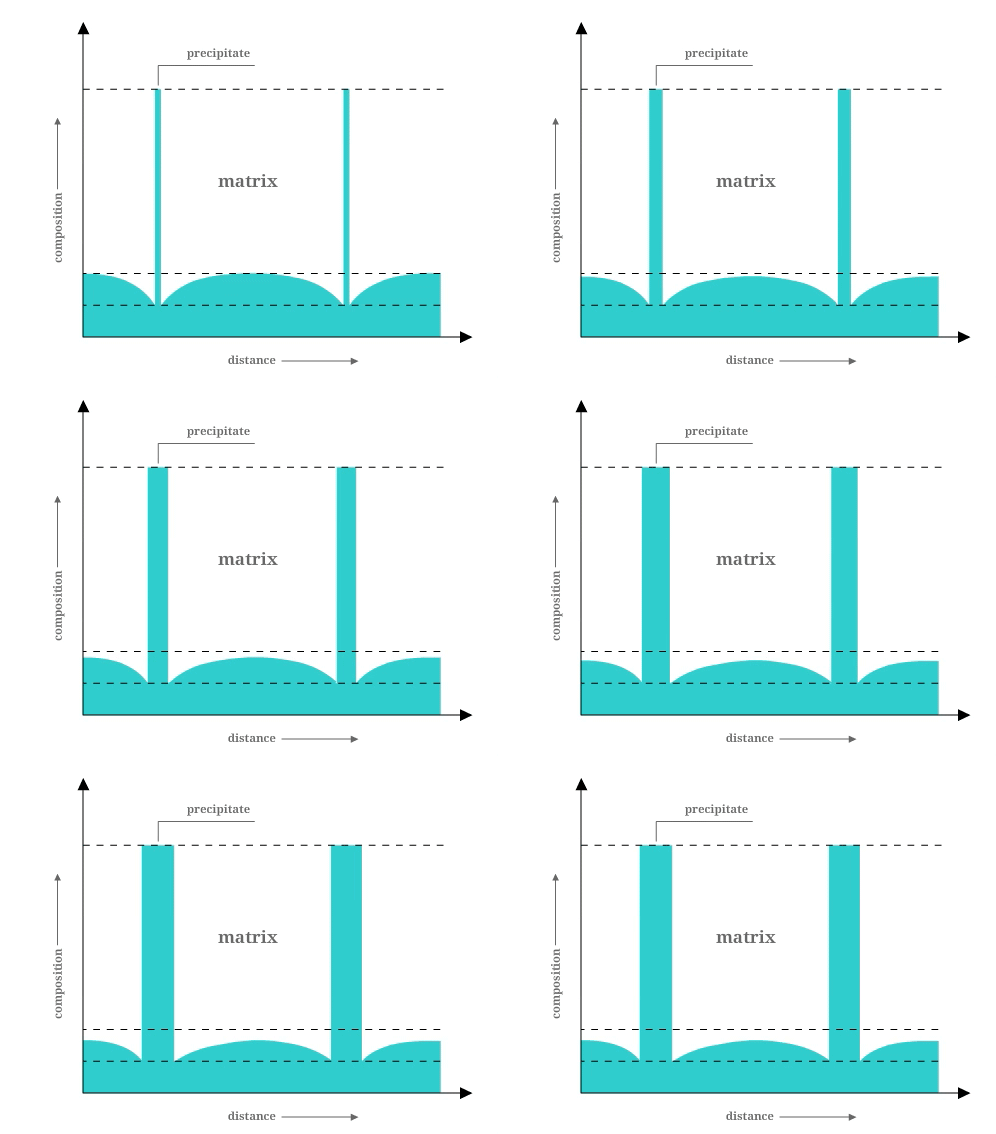
However, it’s expected that the undoing of the growth process would be accompanied by a continuous decrease in U, because various particles grow simultaneously, establishing, in the most advanced steps of the process, a competition for untransformed atoms from the solute still present in the matrix, due to the superposition of “influential areas” between the crystals that are growing. The immediate consequence of this interference is the alteration of chemical composition profiles, as shown in Figure 2.1.19 , and a drop in the value of U.
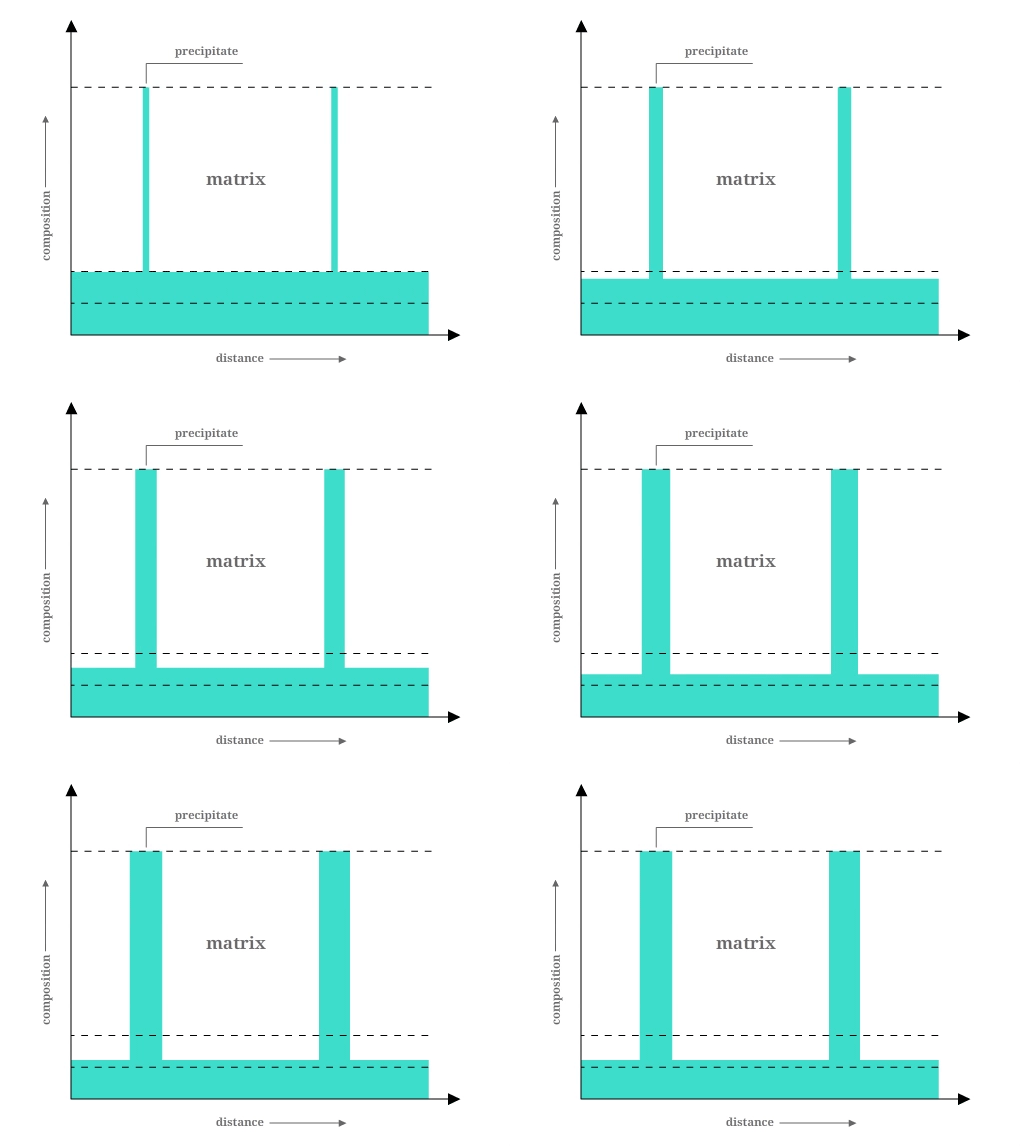
Another alternative is called interface controlled growth. In this process, the time necessary for the atom to cross the matrix/crystal interface is higher than the time it takes to arrive at the interface. Here the solute concentration remains constant throughout the matrix because the act of transport to the interface is so slow that any gradients are eliminated in the solute by diffusion processes.
The entire time the progress of the reaction coincides the the simultaneous growth in various crystals which diminishes the concentration of solute in the matrix, decelerating U, seeing as the driving force for growth is the degree of saturation of the matrix. Figure 2.1.20 depicts this phenomenon.
In the crystalline growth phase it’s correct to think of the diffusion and interface phenomenon as mechanisms that act in series. In this way, the atom will diffuse up to the interface and pass it. When the time spent in this last step is longer than the time spent for diffusion, it can be said that the interface dominated the process.