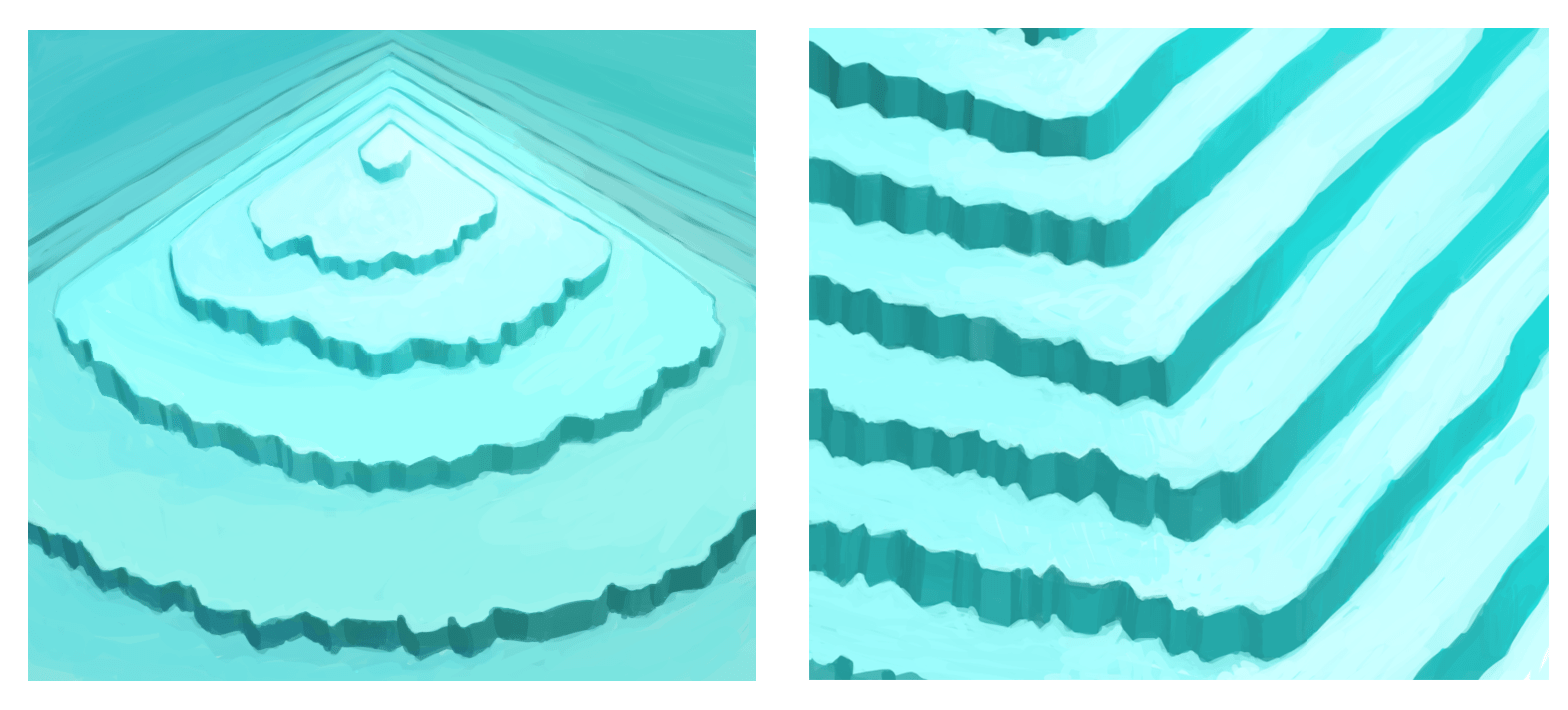
During growth, the surface of the crystal consists of planar regions called terraces, and partially elevated layers are called steps. Due to the presence of dislocations – interruption of planes of atoms in a crystalline lattice – a permanent source of steps, called growth twists (that grow in a spiral from a critical radius r*). The incomplete steps form kinks – extremely important regions because molecules that connect in these areas have more connection area than molecules bonding to terraces or steps. Being formation areas, kinks are also areas where molecules can easily stand out in the crystalline network.
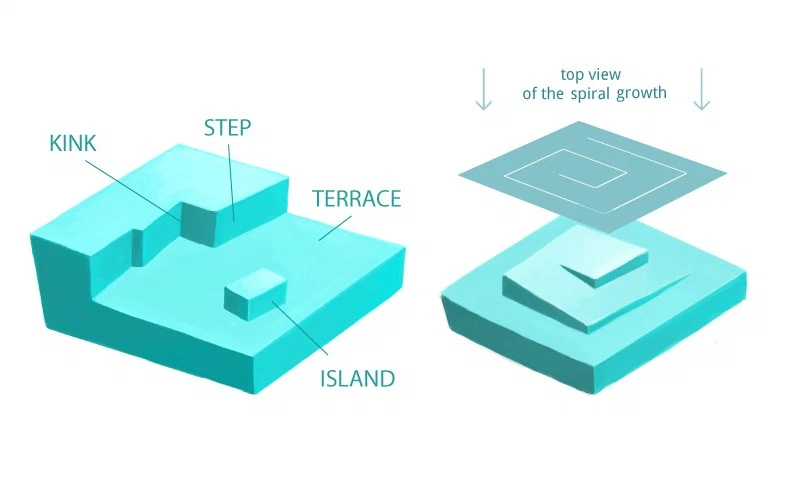
As a result, the rate of attachment of atoms or molecules to the crystalline network is a function of the density of links. The rate of growth can be altered by blocking kinks or augmenting the irregularities of the steps; at the same saturation, the growth rate with rough steps is several times greater than that of smooth steps.