The following shows the development for the equations for the critical radius r* of the solid phase that appears within the liquid, and the activation energy ∆Gv necessary so this solid volume can be formed.
For condensed phase nucleation, ∆Gv can be obtained from the definition of equation (1.1) Gibbs Free Energy (ΔGv=ΔHv-TΔSν). At the solidification point (i.e., when T=Tfusion=Tf) it must be ∆Gv. Therefore:
\[∆Sv= \frac{∆Hv}{Tf} \tag{1.6} \]
With that we can then derive:
\[∆Gv = ∆Hv-T ( \frac{∆Hv}{Tf})\]
\[∆Gv = ∆Hv( 1 – \frac{T}{Tf})\]
\[∆Gv = ∆Hv \frac{∆T}{Tf} \tag{1.7} \]
Eq. (1.7) is a good approximation for temperatures close to Tf. In this expression, ∆T represents the degree of supercooling (Tfusion – T); ∆Hv is the heat of fusion per unit volume. Substituting in the Eqs. (1.4) and (1.5) the value of ∆Gv given in Eq. (1.6), becomes:
\[r*= \frac{2 \gamma Tf}{\triangle Hv\triangle T} \tag{1.8} \]
and
\[∆G*= \frac{16\pi\gamma^{3}(Tf)^{2}}{3(∆H_{v})^{2} (∆T)^{2}} \tag{1.9} \]
Figure 2.1.5 presents the variation of ∆G* and r* with temperature, based on the equations. (1.8) and (1.9).

The γ value is relatively insensitive to temperature but ∆Gv increases its negative value while the temperature is reduced. Equations (1.8) and (1.9) indicate that not only the critical radius reduces with the increase of supercooling, but decreases the free energy necessary for its formation. For sufficiently low temperatures, nucleation can be initiated by just a few atoms that group together forming a particle. The nucleus at critical size in this case is reduced. Therefore it is more likely the nucleation for a big supercooling because the critically sized nucleus in this case is reduced. Figure 2.1.6 represents the effect of supercooling on the critical radius value r*.
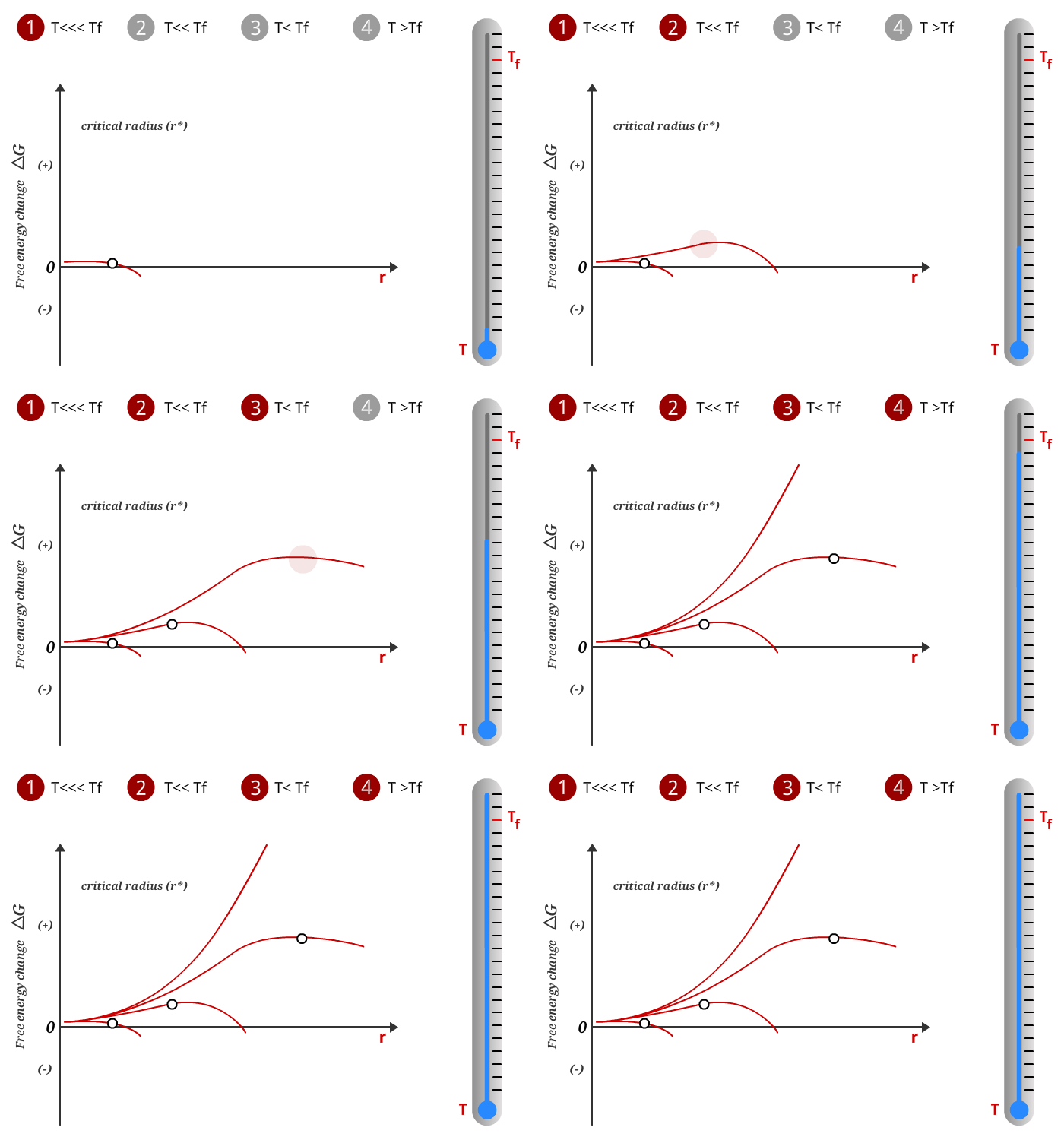
Figure 2.1.6 – The effect of supercooling on the critical radius value r*