Homogeneous nucleation theory, elaborated by Volmer and Weber in 1926, states that the nucleus is a result of the successive addition of individual atoms to the embryo. This is a unidirectional reaction going from the matrix to the embryo. Consequently new atoms will be added at the point where the reaction occurred to compensate for those that were removed. By the proposed model this would not affect any virtual equilibrium already present in the system as the number of nuclei n is not small when compared to the total number of atoms N in the system being studied. This theory does not consider the reverse reaction i.e. once an atom moves to the embryo it will not return to the matrix and assume that the growth process is so slow that it’s possible to consider the number of critical radius groupings n* being the equilibrium number. In the case the number of nuclei of the new phase with critical radius is shown with the following equation:
\[n*=N\times exp [\frac{∆G^{*}}{kT}] \tag{1.10} \]
in which n* is the number of nuclei; N is the number of total atoms or units of molecules; k is the Boltzmann1 constant and T is the temperature in degrees (K).
The nucleation velocity calculation I results from multiplying n* by the growth of critical radius nuclei. This second quantitysup>2 is provided by the following equation:
\[\frac{dns*}{dt}=n_{s}v exp [\frac{∆G_{D}}{kT}] \tag{1.11} \]
where dns*/dt is the growth rate of the critical radius nuclei; ns is the number of atoms that cross the interface per second; k is the Boltzmann constant; T is the absolute temperature; v is the atomic vibration frequency and is kT/h, where h is the Planck constant3; ∆GD is activation free energy to move adjacent atoms to the created interface.
Multiplying the equations 1.10 and 1.11 we get:
\[ I = n_{s}^{*} vexp (\frac{∆G^{*}}{kT}).exp( – \frac{∆G^{*}}{kT}) \]
\[ I = n_{s}^{*} vexp (\frac{∆G^{*}}{kT}).exp( – \frac{16\pi\gamma^{3} (Tf)^{2} }{3kT(\triangle H _ {v}) ^{2}(\triangle T ) ^{2} } ). exp ( – \frac{\triangle G _ {D}}{kT}) \tag{1.12} \]
where I is the rate of nucleation and ns is the value of n when the embryos have a critical radius, ∆GD is the free energy of activation to move the adjacent atoms to the created interface and ∆G* is given by the equation (1.9).
Other scientists (see references in this post) have proposed modifications to this theory. Although more consistent physical models have been introduced, these proposed revisions act exclusively with the pre-exponetial factor of the equation (1.12). In the intervals where nucleation usually occurs, the variation based on the ns.ν is always much smaller than the variation of the exponential term $$[-\frac{\triangle G_{D}+\triangle G^{*}}{\kappa{T}}]$$ Along with this, the precision in the experimental results of the rate of nucleation is not large making it possible to consider the equation (1.12) as adequate. Figure 1.7 presents a graphic of the variation in velocity of nucleation with temperature.
Utilizing the equations (1.7) and (1.9) from the last topic in conjunction with equation (1.12), note that when T is a value close to Tfusion or Tf, ∆T tends to zero, and the first exponential within the equation (1.12) is nullified. This implies that in the fusion temperature, the rate of nucleation should be null. As the temperature falls, ∆G* falls quickly and the speed of nucleation increase. However, ∆G* soon becomes negligible compared with ∆GD; ∆GD is the dominant term in equation (1.12), and N decreases with temperature. Consequently, there is a maximum rate in homogeneous nucleation, that can be located considerably below the fusion point Tf. As temperature decreases, the rate of nucleation begins to be controlled by diffusion, that is, the speed that atoms jump between the liquid-solid interface.

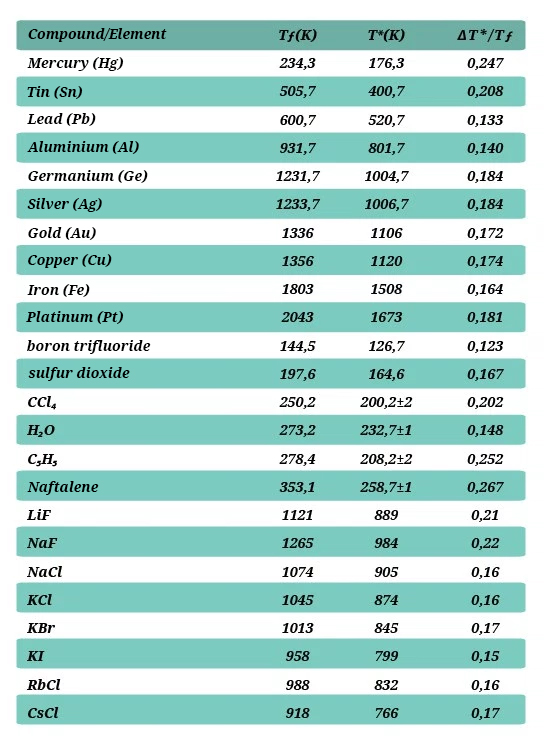
The table below presents experimental values of supercooling of different materials that solidified from a liquid state. In this table, T* is the lowest temperature in which a liquid can be supercooled without crystallizing and ∆T*=(Tf – T*). The most supercooling obtained for these substances is between 13% and 26% less than the fusion temperature of the materials.
1k= 1.381×10⁻²³ J/k
2With regard only to adjacent atoms to the created interface and available to perform the leap to the embryo.
36.62606957×10⁻³⁴ J/s