If D doesn’t depend on the concentration (a hypothesis the should be verified in any real situation), the Equation (2.6) can be written as follows:
\[ \frac{\partial C}{\partial t} = D. \frac{\partial ^{2} C}{\partial x ^{2}} \tag{2.7} \]
Diffusion in a semi-infinite solid describes many diffusion scenarios in a solid state, as in the case represented in Figure 2.2.5, where the concentration C of the species in diffusion varies with the distance of x, with time t and the diffusion coefficient of D. The bar is considered a semi-infinite solid if none of the atoms in diffusion is capable of reaching the far edge of the bar during the time of diffusion. Frequently the source of the component that is being diffused is a gaseous phase as long as partial pressure is maintained constant.
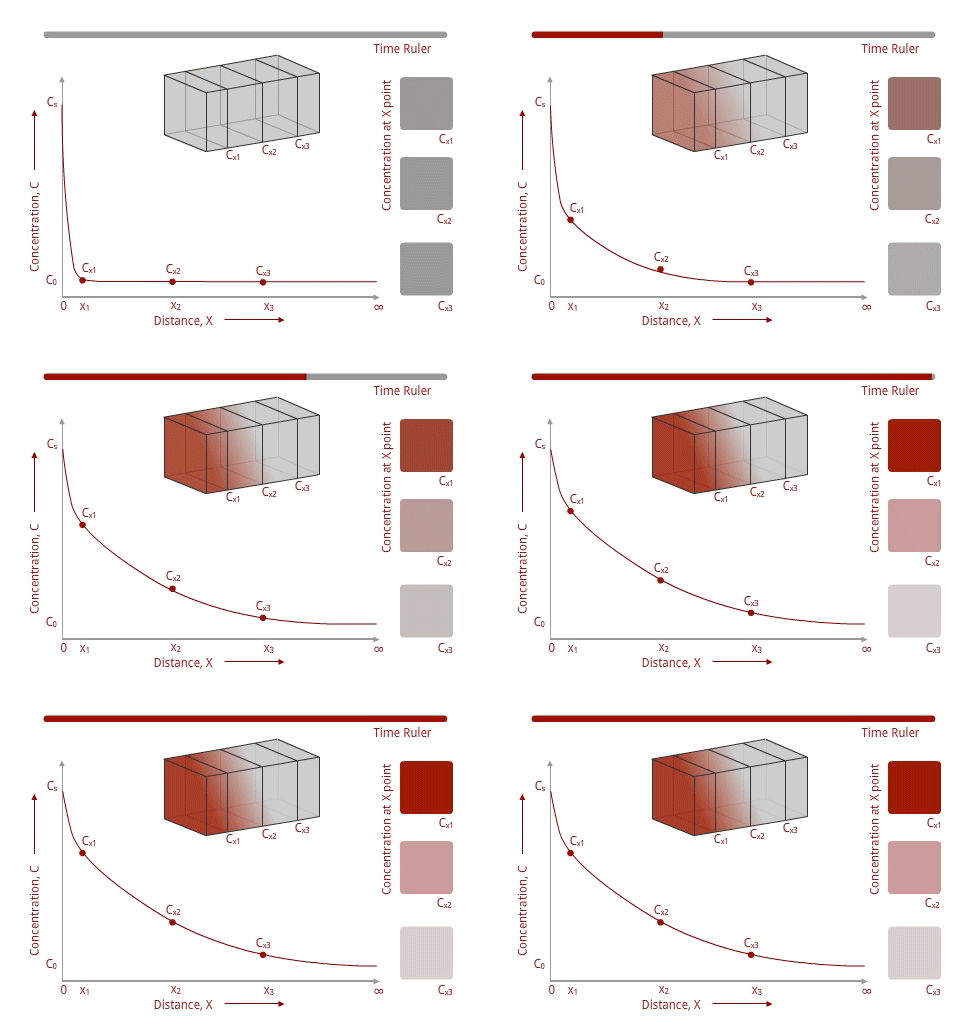
This is the case, for example, of carburization1 of the surface of a piece of steel. In this process, a low carbon steel (relatively strong, but soft), is heated in a carbon rich atmosphere, in such a way that it can diffuse in the steel, producing a hard shell rich with carbon.
1In metalurgy, carburization is the process by which material is diffused through another, altering its properties, in lower temperatures than the melting point of the two materials. Along with the surface hardening process with diffusing carbon (C), other processes are used commercially like nitriding (adding of nitrogen – N), siliconizing (adding of silicon – Si), etc.