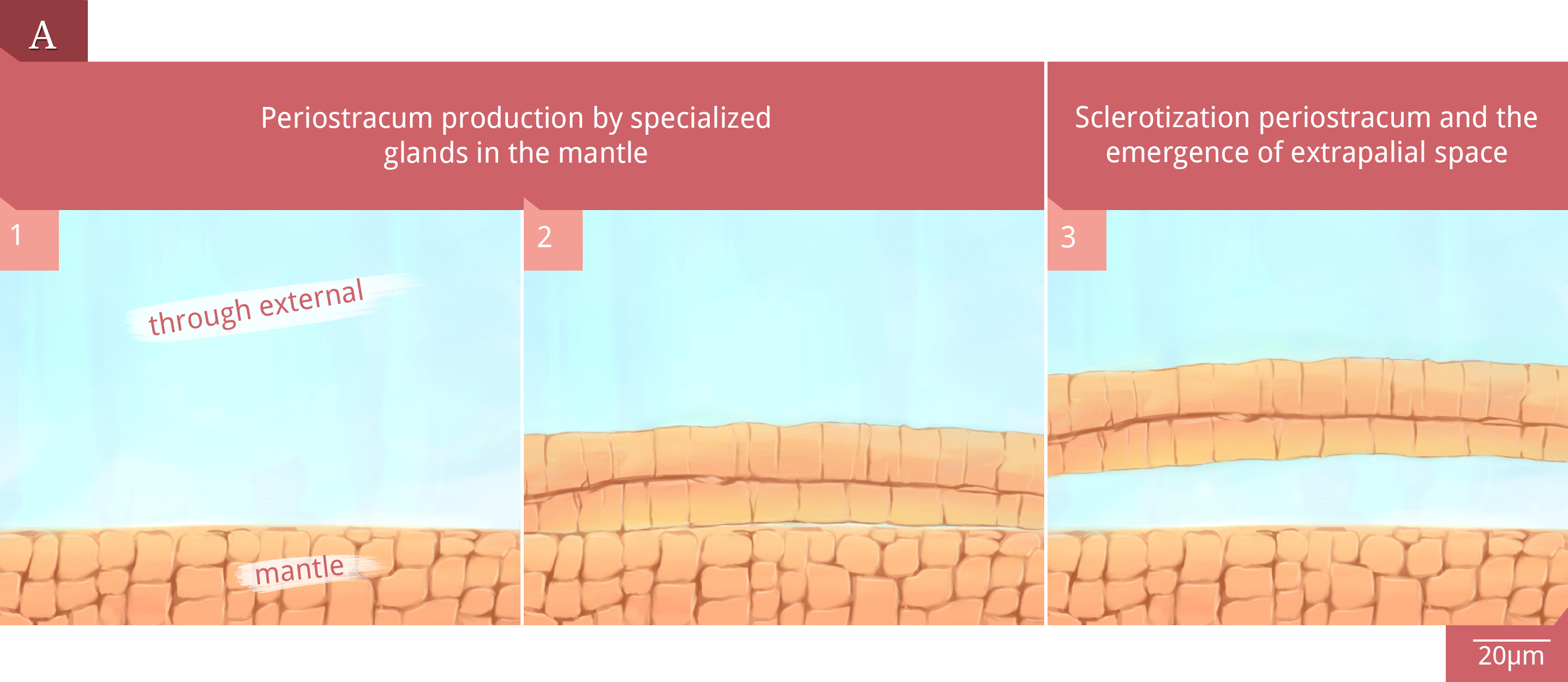
Mollusk shells begin forming in the larval stage of development with the production of periostracum (Figure 5.11a), proteic tissue that isolates the extrapallial space from the external environment. The periostracum goes through sclerotization (a hardening process regulated through chemical factors) and turns into the first layer of the shell. The extrapallial space, limited by the periostracum and the mantle, acts as a reactor where the shell will be formed by deposition. The golden mussel then controls the composition of the liquid that fills the extrapallial space, producing a supersaturated solution rich in Ca2+, CO32-, Mg2+, among others. By altering the pH of this liquid through the introduction of CO2 arising from the respiratory cycles, the mollusks stimulate the mineral deposition process (nucleation) (Figure 5.11b).
The first mineralized layer of the golden mussel is call the “Cloud Layer”, because of it’s poorly defined morphology. Mainly made of calcite, this layer is deposited on the internal surface of the periostracum (Figure 5.11b), and acts as stable substrate where the other layers will be deposited.
The next layer, called Nacreous layer, are deposited simultaneously on the organic matrix that act like a scaffold, where aragonite is nucleated to form hexagonal tiles (Figure 5.11c). Each tile is composed of nanometric crystals cemented to the organic matrix. The nacreous layer makes up more than 80% of the transversal section of the golden mussel shell.
The last layer is called the Prismatic Layer. It’s deposited over the nacreous layer (Figure 5.11d). Made up of aragonite prismatic pillars, this layer stays in direct contact with live tissue of the organism, mostly the mantle. The production of this layer, that internally surrounds the shell, is sometimes associated with the reduced availability of nutrients. This is why they can be encountered several times along a transversal cut of the shell denominated as Mesolayer.